
Halo-halo, that mix of boiled, sweetened rootcrops, beans and saba bananas, with a handful of shaved ice lodged in, poured with a dollop of milk, then topped with a thin slice of leche flan and a spoonful of ube pudding, is the ubiquitous favorite Filipino summer snack. By February every street corner across the country sprouts a table laden with jars of the ingredients and a chestful of block ice on the side.
It's already the first week of April, but the winds have been blowing cold at night, and LPAs have been hovering over the islands, that it doesn't feel like summer yet. PAGASA even declares that it's not yet summer season. So it's not surprising that I rarely see halo-halo tables so late in the season. Perhaps because holy week is late this year.
Anybody who knows how to boil and dice, and has the grit to manually shave ice, can put up a halo-halo stand. But some people have been at it for so long they are institutions in the industry, and their halo-halo are worth having even through the raging of typhoons, summer or not.

Digman halo-halo is familiar to mall rats in the past as it used to be a mouth-watering presence in all the food courts of Metro Manila malls. It has since disappeared from mall basements, but Digman still exists, though now its operation is limited to the hometown from which it originated.
Digman is actually a place – a sitio of the municipality of Bacoor, the first town in the province of Cavite after the Coastal Road. The area has become a tourist spot, a sort of stop-over for travelers going to Tagaytay and the beaches of Batangas on weekends, as well as a destination unto itself for serious foodies.
The hallowed halo-halo destination is composed of two streets at a right angle to each other, and on each alley is ensconced an eatery proclaiming it is the original Digman halo-halo. I know each eatery has its own followers, but the offerings look the same, and I can’t much tell the difference, so I think either one will do.

Digman is the embodiment of the Filipino streetcorner halo-halo. Sweetened legumes, saba and langka, coconut products – kaong, macapuno, nata de coco - jelly cubes, sago, and the ube and leche flan topping.
But while your streetcorner halo-halo would only contain ingredients that’s perhaps what’s available in the market that day, or maybe what’s cheap, or what the vendor feels like including, at Digman you are guaranteed of its byline, Sang Dosenang Sarap, always a dozen unvarying ingredients throughout the year.

That guarantee is evident in the halo-halo itself – served in a bowl instead of a tall glass, so that the delicious dozen can all fit in.

Asiong’s Carinderia is a sort of an institution in Cavite City. People say it’s been there forever, and locals recount childhood memories of going out to eat at Asiong’s with their families.
I’ve only been there twice, so I can’t account for much of the food, but I’ve had the halo-halo. And it’s the quintessential halo-halo - chunky, bean-y, chewy, full of contrasting textures and flavors, rounded off by the creamy milkiness of the shaved ice.
Asiong’s halo-halo is quite close to Digman’s, that I think this is how halo-halong Kabitenyo is, or at least in this part of Cavite.

Halo-halong Kapampangan is best known for the halo-halo made popular by Razon’s, and, lately, Kabigting’s. They both started as home-based enterprises, but are now bywords in malls. Razon’s, particularly, have gone as far as General Santos City in Mindanao, so is now known nationwide, though I've heard the quality is not consistent in all branches, especially in the franchise outlets.
Halo-halong Kapampangan is quite the opposite of halo-halong Kabitenyo. Whereas the latter guarantees as much as a dozen deliciousness, the former is minimalist - the least possible number of ingredients that can be called a halo-halo.
Razon's only has leche flan, macapuno strips, and sweetened saba. All three are in such minimal size they are almost mashed up, so that they meld together in every spoonful.
With scant ingredients the halo-halo can only take off with the quality of each component. And each ingredient of Razon's halo-halo is a fine example of the well-known Kapampangan fastidiousness.
Razon's halo-halo is not a macho halo-halo - with the almost mashed ingredients it obviously doesn't have brawn. It's not for those who like chunky halo-halo, but rather for senior citizens, and it's a child's dream halo-halo.
I didn't like beans in my halo-halo when I was a child, and chickpeas, and kamote. So I rather squeal like a child again every time I have a glass of Razon's.
Related PostsIt's already the first week of April, but the winds have been blowing cold at night, and LPAs have been hovering over the islands, that it doesn't feel like summer yet. PAGASA even declares that it's not yet summer season. So it's not surprising that I rarely see halo-halo tables so late in the season. Perhaps because holy week is late this year.
Anybody who knows how to boil and dice, and has the grit to manually shave ice, can put up a halo-halo stand. But some people have been at it for so long they are institutions in the industry, and their halo-halo are worth having even through the raging of typhoons, summer or not.

Digman halo-halo is familiar to mall rats in the past as it used to be a mouth-watering presence in all the food courts of Metro Manila malls. It has since disappeared from mall basements, but Digman still exists, though now its operation is limited to the hometown from which it originated.
Digman is actually a place – a sitio of the municipality of Bacoor, the first town in the province of Cavite after the Coastal Road. The area has become a tourist spot, a sort of stop-over for travelers going to Tagaytay and the beaches of Batangas on weekends, as well as a destination unto itself for serious foodies.
The hallowed halo-halo destination is composed of two streets at a right angle to each other, and on each alley is ensconced an eatery proclaiming it is the original Digman halo-halo. I know each eatery has its own followers, but the offerings look the same, and I can’t much tell the difference, so I think either one will do.

Digman is the embodiment of the Filipino streetcorner halo-halo. Sweetened legumes, saba and langka, coconut products – kaong, macapuno, nata de coco - jelly cubes, sago, and the ube and leche flan topping.
But while your streetcorner halo-halo would only contain ingredients that’s perhaps what’s available in the market that day, or maybe what’s cheap, or what the vendor feels like including, at Digman you are guaranteed of its byline, Sang Dosenang Sarap, always a dozen unvarying ingredients throughout the year.
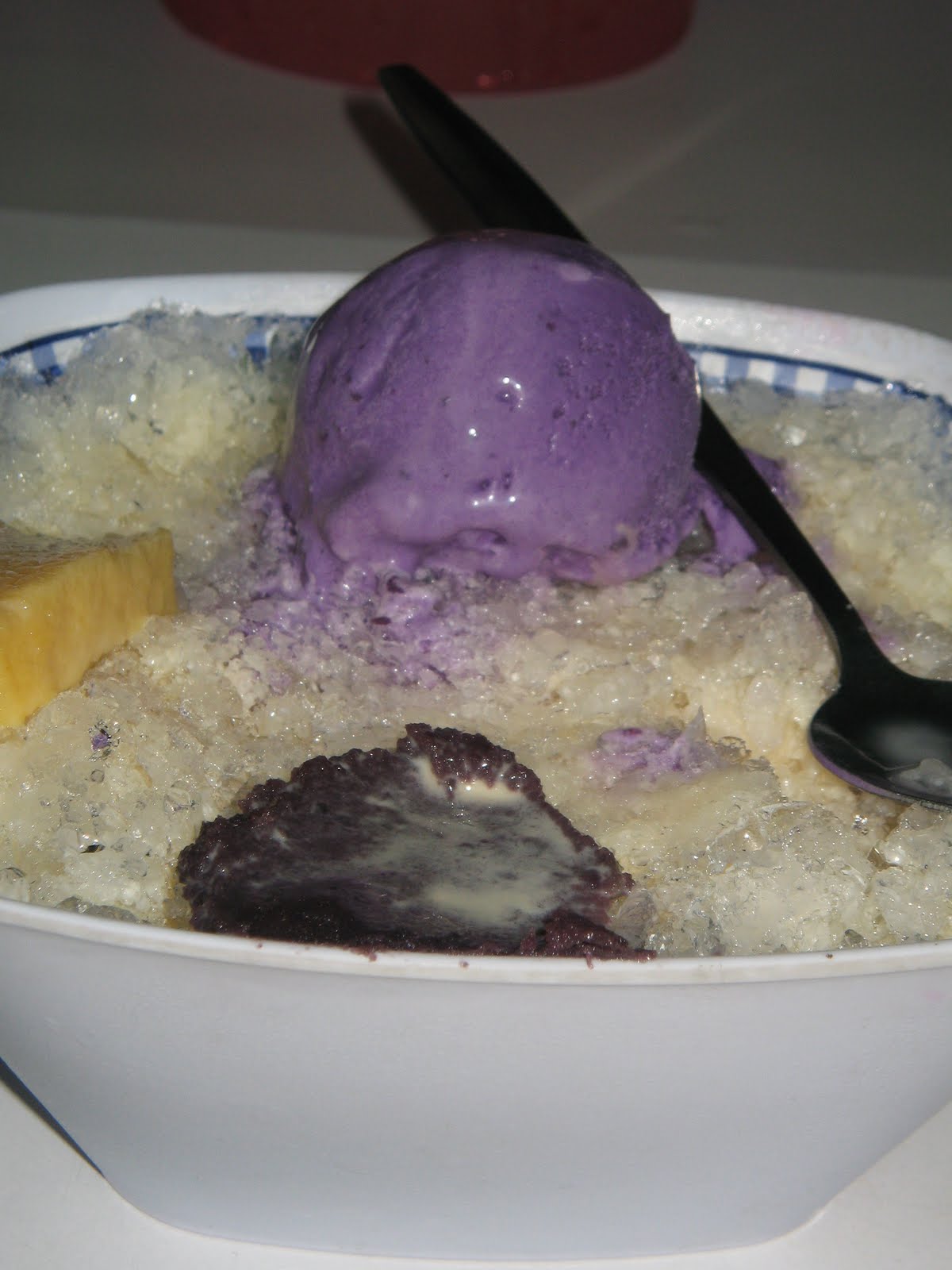
That guarantee is evident in the halo-halo itself – served in a bowl instead of a tall glass, so that the delicious dozen can all fit in.
Digman Halo-Halo
Digman, Bacoor, Cavite

Asiong’s Carinderia is a sort of an institution in Cavite City. People say it’s been there forever, and locals recount childhood memories of going out to eat at Asiong’s with their families.
I’ve only been there twice, so I can’t account for much of the food, but I’ve had the halo-halo. And it’s the quintessential halo-halo - chunky, bean-y, chewy, full of contrasting textures and flavors, rounded off by the creamy milkiness of the shaved ice.
Asiong’s halo-halo is quite close to Digman’s, that I think this is how halo-halong Kabitenyo is, or at least in this part of Cavite.
Asiong's Carinderia & Cafe
719 P. Paterno Street
Caridad, Cavite City

Halo-halong Kapampangan is best known for the halo-halo made popular by Razon’s, and, lately, Kabigting’s. They both started as home-based enterprises, but are now bywords in malls. Razon’s, particularly, have gone as far as General Santos City in Mindanao, so is now known nationwide, though I've heard the quality is not consistent in all branches, especially in the franchise outlets.
Halo-halong Kapampangan is quite the opposite of halo-halong Kabitenyo. Whereas the latter guarantees as much as a dozen deliciousness, the former is minimalist - the least possible number of ingredients that can be called a halo-halo.
Razon's only has leche flan, macapuno strips, and sweetened saba. All three are in such minimal size they are almost mashed up, so that they meld together in every spoonful.
With scant ingredients the halo-halo can only take off with the quality of each component. And each ingredient of Razon's halo-halo is a fine example of the well-known Kapampangan fastidiousness.
Razon's halo-halo is not a macho halo-halo - with the almost mashed ingredients it obviously doesn't have brawn. It's not for those who like chunky halo-halo, but rather for senior citizens, and it's a child's dream halo-halo.
I didn't like beans in my halo-halo when I was a child, and chickpeas, and kamote. So I rather squeal like a child again every time I have a glass of Razon's.
Razon's Halo-halo & Palabok
Website
Facebook Page
Kabigting halo-halo used to be, for the longest time, so out of the way in its original outlet in Arayat, Pampanga. But serious foodies organized Kapampangan food tours that included a trip to Kabigting's.
Thankfully, the owners decided to go out of their comfort zone and thought of branching out. There are at least three branches that I know of, at Robinson's Starmills in San Fernando, Pampanga, and at the Marquee and Nepo malls in Angeles City.
Kabigting halo-halo is similar to Razon's in that it has only three ingredients - pastillas, sweetened beans and corn. But the similarity ends there. Kabigting is more brawny, chunkier.
Kabigting Halo Halo
Facebook Page

Streetside Halo-Halo
Ginataang Halo-Halo


