Friday, September 30, 2005

IMBB #19: A Purely Vegan Dish

[Forest Stream Soup, adapted from Cafe by the Ruins Menu]

Sam of Becks & Posh is the host for IMBB#19, and is enjoining everyone to cook something vegan and trick somebody into eating it without revealing that what was served was of a purely vegan form (no poultry, meat, and poultry and meat products, including dairy and dairy products). This, in the hope that people will exclaim, "I can't believe I ate vegan!" after learning the composition of the dish.

However, as Karen of The Pilgrim's Pots and Pans more or less mentioned in her 1st Vegan entry, a traditional Filipino household eats something vegan at least once a day. Vegetables always accompany a fish or meat dish and rice. For those in the countryside, stewed, boiled, steamed, or sauteed vegetables, flavored with bagoong (salted, fermented anchovies) or alamang (the shrimp version of bagoong) or patis (fish sauce, the clear, amber liquid that is a by-product of bagoong-making), would be a sufficient companion to steamed rice.

The bagoong flavoring, though, would disqualify a Filipino vegetable dish for this IMBB, and so I made a soup I always order at my favorite restaurant of all time, Cafe By the Ruins of Baguio City. It is called forest stream soup because the ingredients, fresh shiitake mushrooms and fresh watercress, grow in abundance along streams and and other waterways. One of my good friends said the soup is called thus because it recalled the taste of a stream, or even a river. I'm not sure how a stream actually tastes like, but the soup is a bestseller, and I try to cook it everytime fresh shiitake mushrooms are available in Baguio city.

Which is just about now. And the friend is the only exception in turning an averse shoulder to the soup. Other friends and the hubby eagerly await the rainy season so I could cook my own forest stream soup. Somebody even bought me a whole bag of dried shiitake to substitute for the fresh ones when not in season, but the taste is different. The dried shiitake has lost its earthy notes, and has acquired a packed, intense flavor that overpowers the delicate taste of the watercress.

The shiitake and watercress come in a clear broth, but this is not a light soup. The shiitake's texture makes you think you're eating meat, and it feels thus in the stomach. The sesame oil flavoring will make you drink the soup up to the last drop, and makes it truly Asian.

Here's my recipe. The finished product very closely approximates Cafe By the Ruins' Forest Stream Soup.
1. Slice about 1/8 kg fresh shiitake mushrooms thinly. Pick the young leaves of about 1/4 kg fresh watercress. Rinse both.
2. Saute in a little corn oil some crushed garlic, adding sliced onions when the garlic has browned a little.
3. When the onions have turned transparent, add the watercress and stir a little. Add 4 cups of water and turn up the heat.
4. Let boil, then add the sliced shiitake. Add some salt and finely-ground white pepper. Stir and cover.
5. After a minute, turn off the fire. Pour a drop of sesame oil and mix into the soup. Serve hot.

With this, my friends, the hubby and I will gladly eat vegan! Anytime, if only fresh shiitake are available year-round.

And Sam has started with the first of about 3 1/2 round-ups! Yes, the entries were that many!

Tagged with: +


Other posts on food at Cafe by the Ruins:
Adobo sa Mangga
Shiitake-Potato Omelet
Lunch at Cafe by the Ruins



Thursday, September 29, 2005

LP 2: Fr. RV's Recollections

Today I am honored to have as guest in my blog, Rev. Fr. Rafael Victoriano D. Baylon, SJ, or Fr. RV for short, who grew up and studied medicine in the Philippines and went to the US for graduate studies, but ended up joining the Society of Jesus. He is now a full-fledged priest, having taken his sacred vows early this year, and taught at the Loyola University in New Orleans before hurricane Katrina struck. He is writing from Spring Hill College in Mobile, Louisiana, and joining us for the September edition of Lasang Pinoy, hosted by Celia Kusinera of English Patis, who wants recollections of food eaten during the typhoon season in the Philippines. Below is Fr. RV's remembrances.

24 September 2005

The windows rattle as the gale-force winds slam against our house without ceasing. The rain pours down on our galvanized iron roof making a sound reminiscent of a discordant percussion piece. Outside the leaves are blown horizontally as branches break off from the trees and tin cans roll noisily along the street. Meanwhile, my two older brothers and I eagerly wait for the wind and the rain to stop so we could go out and play in the puddles or put our paper boats into the swollen creeks and watch as they float swiftly down the canal. But the typhoon is quite strong (it is signal number three (pertaining to the strength of the typhoon-publisher's note) so classes from grade school up to the university level have been cancelled) so we wait patiently inside the house. These are some of the memories I have as a young boy growing up in the Philippines where typhoons are as much a part of life as music and fiestas. But these memories would not be complete without the food we would usually have during such times.

The first thing that comes to mind is champurado which is sticky rice cooked in chocolate powder. This dish is perfect for a cold and stormy day because it is served hot. As a young boy I would volunteer to grate the unsweetened pure chocolate since that meant I could eat some of it while doing the job. It is interesting to note that after all these years I still have a very vivid image of the Antonio Pueo cacao cylinders that we used for this dish. Before eating the champurado I like to mix in some milk and a little sugar as well. And just like the cherry on top of a sundae, champurado would not be complete without dilis or dried anchovies sprinkled on top. During one of my visits to Mexico I was surprised to find out that they also have champurado there.

Another dish is ginatan. Although I like eating this dish while it is still hot, I also enjoy eating it cold. My brothers would fight over the bilo-bilo or the small, sticky rice-flour balls while I would go after the jackfruit and the camote, a kind of sweet potato. I would often help my mother and the cook make these balls and lay them out on a wet piece of cloth on the table, making sure they were not in contact with one another. The most exciting part, aside of course from eating ginatan, was when my brothers and I would drop the balls into the boiling pot. We often imagined ourselves to be WW II B-24 pilots and the balls we were dropping were the bombs. I guess this tells you a lot about what it was like growing up in a time when there were no personal computers, video games, cell phones or iPods.

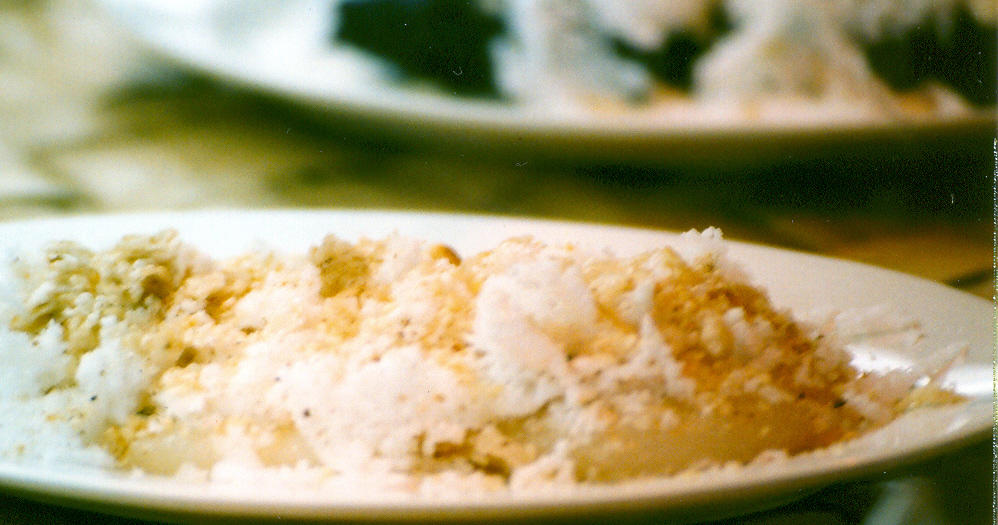
The last dish is called palitaw. This dish is also made of rice flour that is used to make flattened and oval-shaped pieces. Similar to the balls in ginatan, these pieces are dropped into boiling water and would only surface once they are cooked or done. I guess this is where its name comes from since “litaw” means to surface. Once cooked each piece is slightly drained and then coated with grated coconut meat, sugar and toasted, ground sesame seeds.


As I write this, the wind is howling outside as the trees bend dangerously low. It is raining and the puddles on the streets are getting bigger and bigger. I was living in the city of New Orleans until three weeks ago when I had to evacuate to Mobile as hurricane Katrina battered the gulf coast region. It is Rita’s turn this time. I close my eyes and pray. I also imagine having a bowl of champurado, a cup of ginatan and a small plate of palitaw right in front of me. And while these dishes could not reverse the damage wrought by these storms they remind me again, just like they did many years ago, that amid the turmoil in our lives and the world outside, there are some things that always seem to tell us, “This too shall pass”.

Tuesday, September 27, 2005

Lasang Pinoy 2: Cooking Up A Storm

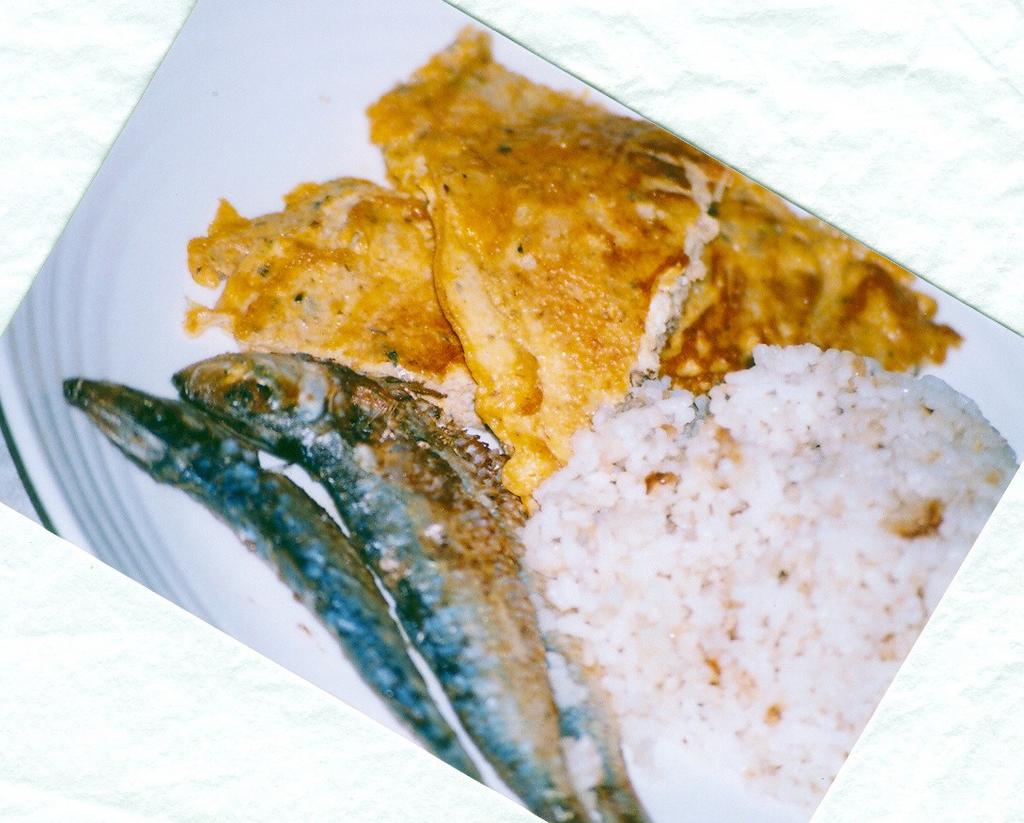
[Fried Tuyo (Dried, Salted Anchovy) and Sardine Omelet]

Celia K of English Patis is the host of the September edition of Lasang Pinoy. The theme, Cooking up A Storm, is very apt, considering the recent havoc wrought by Katrina and Rita. But it becomes more apt when you consider that the Philippines every year experiences quite a number of damaging storms and typhoons, or bagyo (which are how tropical depressions are called this side of the globe, before they go out to the South China Sea and become hurricanes). The bagyo season usually starts in July and ends around October, although we usually have storms up until the end of the year.

Pangasinan, where I grew up, is at the opposite end of Casiguran when it comes to typhoons - while most bagyo enter the country via Casiguran, almost all typhoons exit the territory through Pangasinan, whether or not they chose Casiguran as an entry point. So every year, we make the acquaintance of most typhoons that pass by and ravage the country.

Needless to say, Pangasinenses are no strangers to flying rooftops, uprooted mango trees, flooded ricefields. And floods. Before the Agno River was tweaked and configured, and before the Ambuklao was dammed, we used to have floods about every five years or so. And this was only during typhoons which brought so much rains that the Pantabangan dam had to be opened, with its waters let loose on the lowlands that Pangasinan would be submerged in inches of brown water for several days.

Almost every house in the province has flood marks on its walls. When I was quite small and we used to live in the house of my nanay, my maternal grandmother, we would evacuate to the second floor during flood season because waters would reach halfway up the ceiling.

It was not much of an inconvenience, since the kitchen and the toilet were in the second floor, and we only had to transfer our beddings. And being cooped up in the second floor was not too boring, because there was a big, capiz window facing the street where I could look out of. The street scene would be so serene, what with all the murky water barring all vehicles from coming and going.

Which meant no market for us folks - no vendor could go there and sell anything, and no customer to buy anything. And that's when the sari-sari stores make so much, with their shelves fast emptying of previously-frowned upon canned goods and dried fish.

There's usually no power during storms and typhoons, so my mommy usually cooked whatever was in the refrigerator. When all the provisions have been used up and the waters have not receded and there is no electricity yet, Nanay goes to the sarisari to buy eggs, tuyo and sardines.

I particularly remember one dark night, with fire raging in the dalikan (clay stove), I had my hands under my chin with my elbows on the dining table. I wasn't particularly feeling anything, it was just a nice, comfortable posture and all for my child's sensibilities, but my nanay said not to fret and not to be sad, because there is scrambled eggs with the tuyo.

Now, in Pangasinan, tuyo means dried anchovies. I never saw any fresh anchovy, and there is no other dried fish except dried anchovies (of course not counting one of Pangasinan's main produce, daing na espada, or dried swordfish). When I came to Manila I was shocked by the variety of fish that are dried (I think all kinds of fish are dried and salted). But when I crave tuyo only dried anchovies will placate me. I think this is the tonsoy sold in supermarkets, whose scales flake off easily when fried. The scales are how we determine how salty the tuyo is - if they look flaky, most often than not they are so salty you have to soak them in vinegar overnight (or in milk, to be sophisticated).

So during typhoons the tuyo is supplemented with scrambled eggs or, as my not-so-culinary mother invented, sardine omelet. This is not really omelet, but canned sardines in tomato sauce mixed with beaten eggs, then fried like a pancake. The omelet acquires an appetizing orange hue (appetizing at least for me as a kid, though I still find it so until now) from the tomato sauce.

This combination has been elevated to the status of comfort food for me that I now cook it occasionally - when the craving strikes, when I'm particularly down and out, when it is raining, when I haven't gone to the grocery in a long time and the provisions have ran out, or just when I'm not feeling so creative about breakfast fare.

It has lost its mark as typhoon food anyway, since now we get flooded almost every year, due to the "authorities" tweaking and configuring the Agno River, and the damming of the Ambuklao. The floods arrive often, but the waters recede fast. We have moved houses, too, and the new location doesn't get flooded. The market is just two blocks away, and there are many detour roads now to the market or to Dagupan City. We just have to contend with bangus that are so cheap the vendors almost want to give them away. This because they are harvested before a potentially damaging storm, and they quite literally flood the wet markets.


Thursday, September 22, 2005

Blog Party: Tiki!

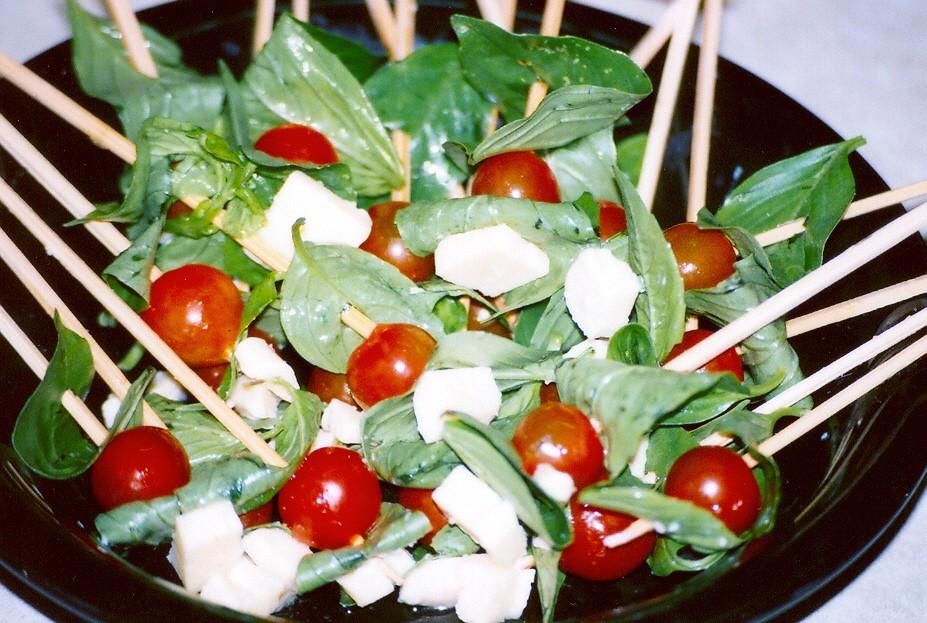
[Salad Sticks]

My Flynn bailed out* yesterday, and is now waiting for flying school graduation ceremonies next week. I'm one proud birdie, and one way to brandish my pride is to cook up a party! Not a full-blown party, though, since I'm reserving this for the graduation ceremonies one week away, but a simple one to celebrate an accomplishment and indicate my relief, and also in nostalgic remembrance of those who did not make it.

No, I'm not inviting anybody to the house, not yet, again that's for next week, but I'll be partying in cyberspace through a virtual blog party hosted by Stephanie!

Others have already arrived, bearing their creations. To the tune of Deep Forest's Pacifique, let me describe what I have on my cocktail table.

Salad Sticks
This is my variation of a recipe I found in the internet (sorry, I can't remember where...). Fresh salad that is finger food! It is simply assembling basil leaves, cherry or grape tomatoes and pineapple tidbits in small barbecue sticks or party toothpicks, dusting them with salt and pepper, and drizzling a few drops of olive oil.

The original recipe called for fresh mozzarella (I once used salty kesong puti from cow's milk, which contrasted very well with the tomatoes and sweet basil), but I substituted it with pineapple for this tiki party. The pineapple heightens the restrained sweeteness of the basil, enlivening the salad. It is a salad that is so friendly that the host does not have anything to toss, there is no need for plates and salad forks, and one stick, complete by itself, provides a crunchy mouthful.

Dalandan Slush
Laranghita, or dalandan in Tagalog, is a local citrus fruit that is not as tart as the local calamansi (key limes?) but is sweeter than an orange. Its being smaller and flatter than the orange earned itself its name, which is a corrupted Spanish term for little naranja (orange). This little orange's rind, like the calamansi's, stays green even when ripe, but the juice is bright sunshine. Processed in a blender with ice and some sugar syrup, this is a refreshing, tangy drink that sparklingly accompanies the dulong pate.

Dulong Pate
Dulong are these minute fish, said to be anchovy fry, that are abundant in the waters surrounding the Philippine archipelago. They are so plentiful that they are dried under the sun and sold as daing na dulong (dried dulong). Fried, they are so crispy, intensely flavored and packed with calcium and protein, good for breakfast with scrambled eggs and sinangag (fried rice). They also lend a salty flavor to stewed vegetables. Dulong can also be bought fresh from the wet markets and groceries, and these can be made into savory tortas (fried, floured patties), or as an appetizing dip for soda crackers and corn and potato chips.


Here is a recipe for Dulong Pate:
1. Rinse 1/4 kg fresh dulong and put in a strainer.
2. Mince very finely a clove of garlic and a thumb-sized ginger root.
3. Cook the garlic and ginger in 4-5 tbsps of white coconut vinegar for two minutes, without stirring.
4. Turn up the heat, then mix in the dulong, sprinkling a dash of table salt and finely ground pepper. Stir gently until all the fish turn white.
5. Turn off the fire and pour enough olive oil to coat the dulong.
6. Transfer dulong pate to a sterilized jar, and refrigerate at all times.
7. To serve, heat on low. Best as a dip for spring onion soda crackers.


Here is the guest list and party food! Makes you want to join the next party!

*Bail out is the term in the flying industry for a pilot ejecting himself from a troubled aircraft, but is also a term for the ritual that is done upon landing from the trainee pilot's concluding flight leading to graduation. This involves the now full-fledged pilot taking his helmet and parachute from the plane and running from one end of the runway to the other, all of 5,000 feet, or more, all the while being bussed by the crawling plane he has just flown. The parachute is quite heavy, the runway long, and the prospect of being trampled by your own plane when you are about to graduate is unnerving, so this pilot certainly deserves a party!

Wednesday, September 21, 2005

Bisukol ed Salumagi


[Kuhol sa Sampalok/Snails in Tamarind Broth with Kangkong]

Snails cooked in broth soured with raw tamarind fruit is a rainy day dish in Pangasinan. The rainy season, from July to September, floods the ricefields and inundates the waterways, prompting the snails to emerge from the ground and congregate by the numbers.

Snails are one of the few food resources which thrive uncultured. They have survived, so far, the poisons that we feed our environment, because of their prolific nature. During the rainy season, cylinders of gray eggs can be found attached to the insides of palay leaves and other plants growing along streams and creeks. This is different from the pink cylinders, which look like flowers, attached to plants growing in the canals. These are the eggs of the big, "golden kuhol" variety, not endemic to the country, which laboriously crawl on the pavements and up walls, leaving long wet trails.

Before cooking, the snails should be left first in a pan full of water for a few days so they could spit out whatever they had previously eaten. I always forget to leave the pan covered, so after a few hours the snails are all over the kitchen and I have to scoop them back to the pail.

When they are ready to cook, the snails' bottoms are patted down with a heavy flat sandok (wooden spatula for serving rice) until they break (as a kid I emphatized with them, having received my fair share of slipper sole "pats" on my butt). This so the flesh comes out easily when cooked.

The proper, and fun, way of eating a bisukol is to pick one up with your right hand, the snail's operculum (opening) facing down your plate, then banging your right wrist onto your left wrist until the snail meat comes out and drops on your plate. Then you fork it to your mouth, and take some spoonfuls of the broth. I like the way the snails are chewy with a soft, rubbery consistency, notwithstanding my sore wrists. They taste of the earth from whence they came and which sustains all the life around us.

I have seen some snails served in restaurants, cooked in gata (coconut cream). I've never tried snails cooked this way, because Pangasinan cooking makes use of gata only with sweet dishes, which automatically means desserts, since there is never a Pangasinan fish, meat or vegetable dish that is sweet, only salty or sour or both.

I've been wondering, though, since I've cooked ginataang tulingan (skipjack) and I liked it. Maybe if I found more bisukol.


Related Posts
Bisukol in Cagayan Valley
Wild Dwarf Crabs
Frogs in Soup
Curried Frog Legs

Friday, September 16, 2005

SHF # 12 - Custard: Halo Halo for the Rainy Day


[Crepe Halo-halo with Hot Custard Sauce]

The rains have been pouring for days, and nights, that temperatures have gone down significantly. The whipping rain, from a low pressure area aggravated by a typhoon brushing past on its way to the northeast, drenches, and reaching home I crave for something hot and comforting, even for dessert.

And this came to mind, exactly in time for the custard theme of the 12th installment of the monthly Sugar High Friday, hosted by Elise.


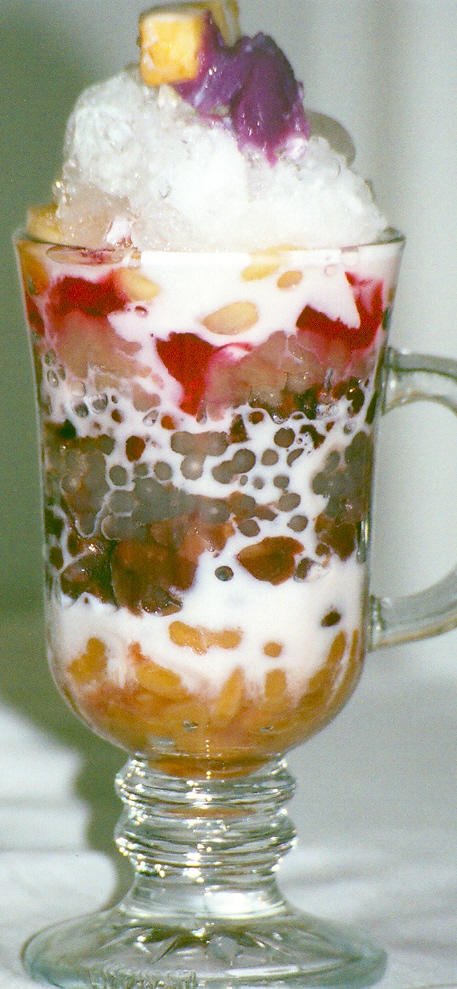
The crepe is my version of halo-halo, the perennial Filipino snack to combat the almost year-round hot weather. Halo-halo is putting together sweetened beans (like lima beans, red mung beans, kidney beans), rootcrops (camote or sweet potatoes), saba bananas, gulaman (gelatin), sago (palm pith pearls) in a tall glass, packing them in with sugar and shaved ice, pouring milk on the ice then topping everything off with ube haleya (jam of purple yam), ripe langka (jackfruit), leche flan (lemon-custard flan with caramel sauce), and toasted pinipig (popped rice). It is a bombshell of a snack, sweet, cold, filling, full of wonderful goodies that are actually healthy.

There are similar versions of this snack in the Philipines' neighboring countries, particularly Thailand and Malaysia, whose climates approximate our own.

Halo-halo is loosely translated as "many things mixed together," which is really what the snack is all about. To eat, you must break the packed ice with a spoon to bring it down to the glass, then mixing everything with a few swirls so each and every component gets a fair share of space. Each spoonful that you dip into the glass then contains all the ingredients, providing an assortment of tastes amd textures - from firm to crunchy, to chewy, to soft, to melt-in-your-mouth. The beans and thin round bananas contrast nicely with the small sago balls. And after everything have been chewed and slurrped and swallowed, the milk, having been infused with all the flavors of the ingredients, proves as an excellent recap.

But this is best for a hot, sweltering day. In the midst of raging rains, a hot crepe with all the halo-halo ingredients, topped with a scoop of thick, viscous Good Shepherd Mountain Maid ube jam, langka slivers and leche flan and sprinkled with pinipig, to be drenched in steaming custard in place of the milk, is by no means better. And heavenly. And can be shared in large portions, unlike the halo-halo in glass. Makes for a cozy, even when wet, afternoon.

*All the ingredients are readily available either sweetened (in the Philippines, at least) or to be boiled (in most parts of the globe, too!) in sugar at home. I like them homemade, so I sweetened everything and assembled them together, in a crepe made from pancake mix. No sweat. And I have enough left for a true halo-halo when the rains stop!


And here's the round-up at Elise's Simply Recipes, with a total of 70 entries from 18 countries. A sweet read!

- Thanks to my friend Miguel for the inspiration to this creation.


Related Posts
Halo-Halo for the Summer
Halo-Halong Kapampangan at Kabitenyo
Kiniler

Tuesday, September 13, 2005

Sukang Pinakurat What?


At the Filipino fiesta event of the supermarket at Market!Market! mall last August, I chanced upon this bottle of vinegar with the intriguing name. Always a sucker for anything new, especially when it is food, I bought one trial bottle. It was from Iligan City, that reservoire of waterfalls in north-eastern Mindanao, in southern Philipines. The vinegar was coconut-based, looked like it was flavored with isdang bagoong (salted fermented anchovies), and the label said it was extra hot.

And it was. Almost a lip-numbing fire, but it doesn't linger, and you can take another mouthful right away without resorting to a pitcher full of cold water. It is a world away from the common spiced vinegar, with finger chiles, garlic and pepper. This vinegar had body, and was not too sour. Just a little salt and it gave a whole new perspective to the grilled hito (catfish) I had for lunch that day. It was also a good alternative dip to broiled tilapia, and to anything fried.

One of my food buddies was in Zamboanga that time, and I asked if she knew the vinegar. As it happened, she asked around and found out that her host was a distributor. It seemed the vinegar is being dealt personally, like Avon or Sara Lee, pardon the analogy.*

Somebody from Iligan explained that pinakurat is a method of cooking something very quickly, but was all giggles when I asked why the vinegar was called pinakurat when it was not cooked, even for just a second. She did say it is the indispensable dip for lechon (whole pig roasted in an open pit). As we Filipinos know, lechon in the Visayas and Mindanao is accompanied, not by sarsa like in Luzon, but by vinegar.

One of my to-do things then is to find a decent lechon. Maybe, in the process of dipping and lip smackingly chewing the golden, crackling skin and the lemon grass-infused, succulent meat, it will come to me why this suka is pinakurat.


*Now available in most supermarkets in Metro Manila. It has also been imitated by a new product, Pinoy Kurat, which is spicier. 

Wednesday, September 07, 2005

Meme: Childhood Food Memories

[Chocolate-coated chocolate pretzels]

When I started this blog not too long ago, one of the things I wanted to write about was the food I had while growing up in Malasiqui, Pangasinan, particulary those things that have sadly discontinued their existence, in this country, at least. For I believe that the food preferences in our adulthood are somehow shaped by how we ate, or more accurately, what was fed us, in our childhood.

Writing about it documents what was before, the heretofore existent, and partly satisfies the yearning for what is long gone and unreachable. I'm much obliged to Joey of 80 Breakfasts for providing me this opportunity to relive and record my childhood comfort foods.

Here they are.

Suguz, colorful, chewy candies in various fruit flavors. These were brought home by my Uncle Bett every time he took a break from his work as a corporate lawyer in Quezon City. My Auntie Fe regularly sent Cadbury's from Sydney, and my first taste of white chocolate was heavenly, and has become a cherished memory for the novelty, but it is Suguz I prominently remember. Probably because it cannot be found in the country anymore, while Cadbury's is literally flooding the market nowadays. I thought Suguz was locally manufactured because there was a dearth of anything imported in those days, but some people noted in a food forum that Sugus, ending with an s, or Sugas, is available in Portugal and Switzerland. So it was imported, maybe the reason why my Uncle Bett brought home those candies.

Jack & Jill Pretzels, originally in vanilla and strawberry flavors, but the real, oft-imitated hit was the chocolate-coated chocolate pretzels. Introduced in the hippie decade of the 70s I was born into, it was the staple public school Christmas exchange gift, and birthday gift, and graduation gift....! The pretzels were crunchy, even the chocolate version, while the ordinary, unflavored kind had a hint of salt.

Egg-Topped Cookies. These were small, sweet, buttery cookies, with a yellow, slightly burnt top, said to be an egg, which was the selling point of the elders for me to eat them (anything and everything was an egg then - squash was a cow's egg, carrots were rabbit's eggs, etc. I must have been an egg-lover. Well, I still am, I drool uncontrollably when I recall the smell of freshly scrambled eggs. But all I do now is recall - oh the hazards of cholesterol! They decapitate our full enjoyment of life!). My lolo brought home the cookies, in brown paper bags with shiny grease blots in them, from his weekly trips to Dagupan City.


Coconut juice with milk. This is a refreshing drink of coconut water fortified with milk and binalikatkat ya nyog (strips of young coconut meat), sweetened with sugar and served cold. Standard merienda fare at my paternal grandparents' house, where coconuts were always aplenty. I always make this now when I get hold of some buco from the highways of the resort town of San Fabian.

I have so many food memories in my grandparents' house. In the dark, communal dining room, I remember my palms covered with white goo from rolling ground sticky rice into long, thin rolls, then cutting these into small pieces to shape them into balls, to be added to the kiniler, or ginataang halo-halo (diced plantains and rootcrops cooked in coconut cream). But when I ate the anise-fragrant, filling snack I avoided the bilo-bilo, favoring the seba (saba) and camote (sweet potato).

On Sunday evenings we always had tinolang manok na native (free-range chicken in broth), with raw papaya, potatoes, and malunggay leaves, and the chicken's unborn, purely-yellow eggs never failed to land on my plate. The chicken was a bit gamy - pressure cookers were not a fad yet. Native chickens were cooked for hours in banga (earthen pot) on a dalikan (clay stove which held firewood). The better to bring out the flavor that native chicken has more of than the mass-bred white leghorn, which makes it particularly ideal for tinola.

I also had stints removing orange kernels from dried corn cobs, which were always sore-thumb events. But the corn kernels were for the chickens. We ate the soft, sweet, yellow corn variety cooked in emptied oil cans over an open fire.

And the maloko (cashew nuts)! Covered with live coals until they exploded, signaling that they were ready to be pounded by a stone to get to the broiled nut. And the lomboy (duhat), sprinkled with salt and shaken in a covered container until they were mushy and oozing with violet juice. We could not cope with the huge duhat tree's production when in season, and it littered the driveway with fruit previously pecked by birds and bats. It has since been torn down to make way for the cementing of the perimeter fence.

Thanks again, Joey, for this indulgence, and for the pleasant journey to the past, a virtual trip down memory lane through the tastebuds.

Now it's my turn to read about others' memories. I'm very much interested in the childhood food memories of the following food bloggers - dear Barbara of winosandfoodies.com, who I hope hasn't done this yet, I've checked, but I can't be too sure. Also a relatively new food blogger, Zabeena, whom I know as Lakritz, of A Lot On My Plate. She's on holiday, I'm hoping she could do this when she comes back in time for our Life of Pi book review and menu presentation. And Ting of World Class Cuiscene, who is my kabaleyan by affinity.

Below is the meme tree. When it’s your turn, move down the list, drop number one from the top spot, move the numbers down, and place yourself in the number five spot. Don’t forget to link the blogs (except yours).


1. The Traveler’s Lunchbox
2. Nami-Nami
3. The Cooking Adventures of Chef Paz
4. 80 Breakfasts
5. Bucaio

I'm sure you'll all have a happy time!

Monday, September 05, 2005

The Coffee That Bites


[Pan-toasted kape (talangka/freshwater crabs)]

The rainy season softens the earth, the rains reaching down beneath the ground, coaxing out new life. We see ricefields sprouting green. And we see gurgling waterways filling up with an abundance of creatures, which the rains have brought back to life from hibernation beneath the soil.

So it is during this time that adventures with a hook and a line abound, and the wet markets display the season's harvest - skinned patang (frogs) skewered on sticks; small, freshwater crabs called kape or talangka in Tagalog; the kape's landlubber relative, dakomo; pantat or hito (catfish); bisokol , kuhol (snails).

However, I'm talking about the past, because these creatures are fast becoming rare as a result of our widespread use of chemicals in our environment. People say fertilizers, pest control, palay pest sprays have almost eliminated the things which defines, identifies and differentiates what Pangasinan food, and Filipino food in general, is.

Some of these have resisted being cultured, while the others are not considered a major component of our food scene, thought of only as a delicacy, even an exotic decor, that their kind and their exsitence are taken for granted. I mourn the day when we would all be eating the same thing, cooked the same way.

The dakomo, for example, is almost non-existent. This small crab burrows in ricefields, and can be found by tell-tale holes in the soft soil. My husband tells childhood tales of him and his friends agitating the holes with a stick, then reaching a hand into the hole to grab the unlucky crab. The boys go home with baskets of live crabs, to be scolded by their mothers because crab holes look a lot like snake holes, but that risk adds more to the attraction of the adventure, and boys will be boys.

The dakomo can be distinguished from the kape by its more concave body, and darker color. When cooked, its has more flesh, but less of the kape's red, hard fat that is so good with calamansi on steaming rice, and for which it is famous. Both are cooked traditionally in soup soured with salomagi, sampalok (tamarind), which is also how the bisokol is cooked. But the tiny crabs can be had like their big brother and sister crabs, steamed with a little water then slightly toasted in the pan with some salt, and a little oil if you like them shiny and slicky red.

It is old practice never to cook and serve these crabs in the evenings, as a precaution against developing diarrhea deep into the night from ingesting crabs which were already dead prior to cooking them. So the kape or dakomo have to be caught/bought early in the morning, cooked alive for lunch, and eaten right then and there, the left-overs thrown away.

I found these kape in Dagupan City. The vendor had two batyas of them alive, with eyes popping. Kape are still available because they are freshwater-dwellers, so they have more fighting chance for survival. No dakomo, though. No bisukol and no patang, either. Now when it rains, all I hear are bull frogs calling like, yes, bulls, which is sometimes scary because they make you think a whole herd of runaway bulls is coming. These are a species not endemic to this part of the earth. They scare away the edible frogs, who produce unparalleled, unbelievably choral music, even orchestral music in tandem with the crickets, a celebration of life given by the rains, echoing of happiness for God's blessings.


*Kape is also the general Filipino term for coffee, in almost all languages in the Philippines, including Pangasinan and Tagalog. Hence, the title.


Related Posts
Snails in Tamarind-Soured Broth
Frogs with Amapalaya Leaves
Curried Frog Legs