Showing posts with label from around the world. Show all posts

Wednesday, May 14, 2014

Japan: Rokurinsha

My arrival in Tokyo was a protracted one, despite being on an on-time, 3-hour direct morning flight. I dutifully went to the airport a full four hours before the ETD, which meant I had to leave home around 2AM. As usual I had not slept doing last-minute checks, and I had failed to expect that the budget airline I had chosen to take me to Japan had seats that did not recline (I am never taking a flight with this airline again).

I had known that all food on board was for sale, so I had brought along lunch (no breakfast for me, I had flown from NAIA 1, and all dining outlets there look suspect). But it had been horrible to hear the announcement a few minutes  after we had taken off that consumption of food brought in from outside was not allowed on the flight. Good thing I had a window seat, so I managed to eat on the sly the chicken pie I had bought the day before from Banapple
Anyway, I was at the Narita airport after lunch, and after managing my way around the terminal and withdrawing enough local currency from an ATM, I boarded a bus direct to the heart of Tokyo. The bus ride took approximately an hour, then I spent another 30 minutes or so walking to my hotel, which wasn’t all that far, but I took my time ogling at all the window displays and then some.

And so by the time I had deposited my things, freshened up, and changed clothes, it was close to four o’clock in the afternoon, which meant I had about thirty minutes of daylight left. I had planned on going to Shibuya on my first day in Tokyo, to have a photo taken with Hachiko to fulfill the promise I had made to the kids. So I hurried to the Tokyo train station, which was a ten minute walk away.  
at past four on a Monday afternoon

While I tried to locate the right ticket booth, I chanced  upon this long line of people clad in what looked to me to be office attire, each one toting a briefcase of some sort. I wondered what were office workers doing out queuing to eat at that time of day? Did office days end early in Japan?  But the most important thing I hadn’t known at the time was that I had come upon ramen alley at the basement of Tokyo station by mistake.

My trip to Japan was for eight days, but this time I did not search every nook and cranny of the internet looking for recommendations on where to eat. This was because Japan was known all over to be an expensive destination, and if I find recommendations to places that turn out to have unreasonable prices, I’ll just be disappointed for the length of my trip. So I decided that I’ll eat wherever I find myself during mealtimes.

It wasn’t mealtime at past four, but seeing that long line made my stomach growl, out loud, and I instantly remembered, and felt, that I haven’t had a decent meal since the previous day.  So I decided Hachiko wasn’t going anywhere and could wait for my visit on another day, and promptly fell in line, which at the moment hadn’t turned the corner yet.  I hadn’t known it then, but I just fell in line for the second most famous tsukemen in all of Japan, and that people queue for it for hours in snaking lines.

I didn’t even know what the shop was called, as the sign did not have an English subtitle, or what it sold. But the line moved briskly enough, and I was able to peer in through the windows, seeing that people were slurping on what looked like udon. I thought it was perfect, that I'd get to eat a hot bowl of noodles on my first day in cold Japan.

Soon, in under twenty minutes, I was able to peek at what’s going on at the end of the line. There was this good-looking usher who asks how many persons for a table, guides the first ones in line to the ticket vending machine, on to the available table, then  comes back to repeat the process.

At around seven on a weekend morning 

I was able to make out the prices at the vending machine from my vantage point, but because my head was floating from lack of sleep and proper nourishment I was getting mixed up in converting the prices to Philippine peso, so that they came across as out of my league. I didn’t think of leaving, so near the end of the line, so I thought I’ll just get the cheapest bowl of noodles, and make up for the splurge by spending only so much the following day.

But when it was my turn the usher smiled, and in perfect English declared that the special recommendation was this one, pointing to the slot in the vending machine with the photo and price of the most expensive bowl, which I now know to be called tokusei tsukemen. That usher may have been a charmer, for no matter how rock-solid my resolve was a minute before, I inserted my money into the slot he pointed to.

I was seated at the bar – first-timer’s luck is luck ten-fold – where I could stare, fascinated, at the cooks strutting their stuff. The individuals seated around the bar were all males, with age range of late twenties to about the  fifties. The younger ones were taking photos with their phones as their bowls were handed to them.

The first thing to land before me was a paper apron, followed shortly by my expensive noodles. It turned out to be tsukemen, the massive current Japanese rage, almost  a deconstruction of the ramen  – broad, firm ramen served cold and dry, with an accompanying bowl of thick soup for dipping. Tsuke in Nihonggo is "dip," while the men refers to the noodles, thus tsuke-men

The JPY1,050 price tag had been due to the contents of the soup – everything that could be put on it as topping was there – the iconic slice of kamaboko (pink-spiraled fishball), buta hogushi (shredded pork), a square of nori (seaweed), on top of which is a special house blend of bonito powder, negi (chopped spring onion), and deep down at the bottom of the bronzed soup were memma (pickled bamboo shoots) and thick cuts of tender chashu. There was a whole ajitsuke tamago, marinated soft-boiled egg, firm but with a gelatinous center that was viscous and velvety.
The thick dipping sauce clings to the fat noodles, and there was no way to go about it but slurp, so the apron provided was really necessary. The myriad of ingredients would have been overwhelming if not for that characteristic tangy dimension that yuzu provides. The citrus edge more than just keeps one from taste fatigue, it actually whets the appetite.

Compared with the tsukemen I first tasted in the Philippines, the yuzu angle here is not forceful. It is there, subtly present but not intense, so that entirely the soup comes out well-balanced, with no single component sticking out by itself, all the flavors – umami, salty, peppery, tangy – complementing one another.

As  I ate I maintained my peripheral vision active, so that I saw that the other diners seated along the bar, upon finishing their  noodles, would hand their bowls of soup to the attendants, who would then fill them up from a thermos by the counter. The bowls would be handed back to their owners, who would then finish up the soup, At first I thought, the soup must be unlimited. But as I finished and handed my own bowl, I saw that a hot clear broth was poured on it (soup-wari), thinning the viscous leftovers and making it edible on its own.  Which was thoughtful, because the bowl of noodles is more than a handful, and the lingering taste of that soup accompanied me as I walked happily along the dark, icy streets of Tokyo.

As it was, the tsukemen was an unplanned but very much welcome intrusion in my trip. It boded well for the rest of my stay in Japan – one of the highlights of the entire tour happened right during the first few hours  that I was trodding on Nihon soil. And it wasn't even expensive - when my stomach had been filled and I was thinking right again, I realized the currency conversion I was using was the opposite of what it should be, and the price of the specialty bowl I had just eaten was equivalent to the price of (inferior) ramen in the Philippines. 
Compared with the ramen bars I would subsequently eat in during the course of my vacation across Japan, the table was sparse, carrying only packets of bonito powder and the condiment tray of vinegar and chili oil.
The Tokyo Station
looking very much like a rail station in Europe


Rokurinsha
Website (Japanese)
Tokyo Station Ichibangai B1
Tokyo Ramen Street
1-9-1, 丸の内, Chiyoda, Tokyo 100-0005, Japan


Saturday, April 12, 2014

Hong Kong: Tsui Wah

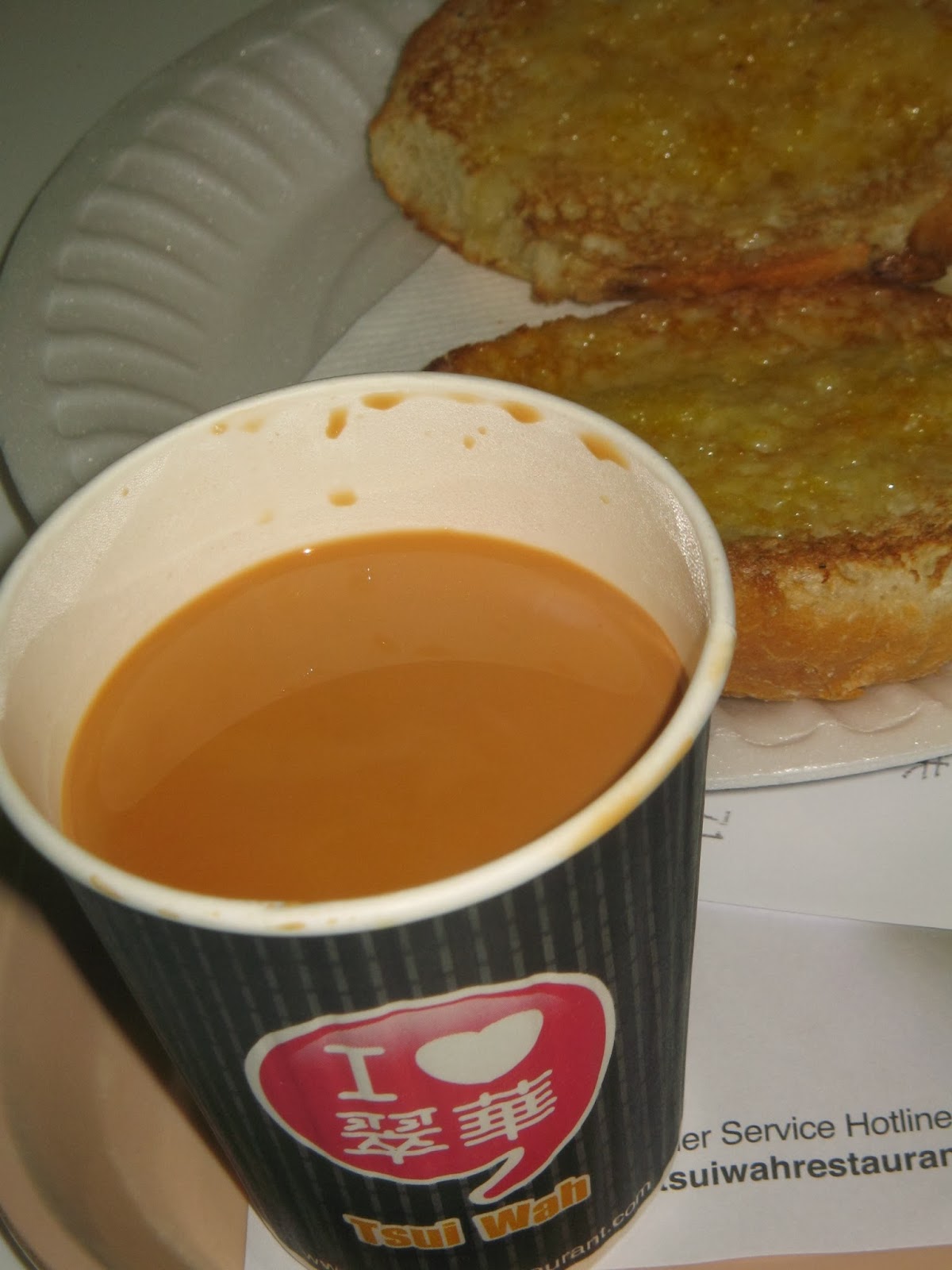
A hot cup of nai cha or milk tea and a couple pieces of sweet buttered toast from Tsui Wah, plus a bowl of fish noodle soup,  were the last things I had upon leaving Hong Kong.

Tsui Wah’s buttered toast was one of the things that made an impression on Anthony Bourdain during the Hong Kong episode of The Layover. I found the shop by the busy Des Voeux Road Central, on the other side of Connaught Road Central along which it is parallel, a large tea house all in glass walls and windows. But this must not have been the original stall that Anthony Bourdain visited, for that was just a tiny, hole-in-the-wall affair.


Anyway, trying this and that and looking for other things besides, the chance to try Tsui Wah slipped me by. But still, luck was on my side, because Tsui Wah was at the departure area of the Hong Kong airport. So I arrived early for my flight, and sat down to savor my last hour in Hong Kong with one of the city’s famous offerings. 

The nai cha was how it should be, hot, creamy and not too sweet, the full-bodied tea providing a jolt to the senses. Which reminds me – in all of the four days I traveled along the expanses of Queen’s Road Central to West, Connaught Road Central to West, and Des Vouex Road, and exploring the malls all around Central,  there was only one cold bubble milk tea shop I passed by, and that was a Gong Cha stall. 

Hot milk tea – without the bubbles – can be ordered almost anywhere, though, especially in those tiny, family-run noodle shops. And of course there were all the teahouses serving complementary hot tea to your heart’s content, but without the milk. 
But as for Tsui Wah’s buttered toast, which came slathered with condensed milk, I wasn’t too impressed. In fact upon the first bite I wondered what all the fuss was about. It was just an ordinary bun made chewy by the butter and condensed milk heating up to a slightly crackly thin layer after its stint in the oven. 

It can be easily replicated at home, using better bread and taken to a myriad of directions. With cheese? Cream cheese! Or strawberry jam. Cream cheese and strawberry jam! Or mango jam! Even just simply butter – good, salted butter – and a generous sprinkling of white sugar, grilled until the sugar crystals have almost caramelized.
My bowl of rice noodles and fish balls was bland, as expected. All three were incidentally among Tsui Wah's top ten dishes. Tsui Wah’s milk tea is sold in take-home plastic bottles, so I bought several to compensate for the tetra packs of tea and cans of creams soda in my backpack that immigration officials confiscated because I forgot to insert them into my check-in luggage. The bottles were some of the things I brought home, along with several orders of baked buns from Tim Ho Wan, and a heaping of memories of food newly discovered and rediscovered.
But before I leave Hong Kong entirely, let me include a few other photos taken at the expansive Chek Lap Kok airport. 
  The female CR must be one of the most mother- and child-friendly lavatories in the world.

No, this is not a mirror image. And with that to muse over, I boarded my plane. 


Tsui Wah Restaurant
Website


Related Posts

Friday, April 11, 2014

Hong Kong: Cliftons

The seminar I attended in Hong Kong was held at a Cliftons training venue  right smack in the middle of Queen's Road Central. The venue provider also catered the three-day event, providing breakfast, lunch, and mid-morning and mid-afternoon snacks. 

Before the seminar I wasn't at all happy that I will be provided most of my meals for the day. I envisioned lackluster Western dishes designed to please varying palates - in short, safe and oft-repeated standards. 

And that is what met me on my first day. Breakfast was sausages, eggs and some breads. I had indulged breakfast at my hotel, so I congratulated myself. I wasn't in Hong Kong to eat sausages. 

Lunch, however, was a revelation. There was a total turn-around, and it became hardcore Chinese. There were dishes that even came across as exotic, ones  I could never have come across no matter how hard I scoured the restaurant scene across Hong Kong. I would never have ordered them, for one, if they were available, since they were remotely unfamiliar. But here it came free with the tuition that the agency I work for had paid.  

And there was confirmation of the food's pedigree - my favorite classmate, the one who pointed me to Tim Ho Wan and who explained how to eat congee and soy milk for breakfast, declared that everything was "surprisingly good."

I didn't find everything that palatable, though. That dish above, for example, was labeled steamed angelo lufta and glass noodle in garlic. I'm sure there was some sort of mistranslation or misspelling there, for no matter how I researched I could not find what lufta or angelo are anywhere. But it's some kind of gourd, very much like sponge gourd or patola (which is spelled luffa), but not as slick, and very, very bitter. It has a different bitterness from, say, ampalaya, or even papait. The large slices further emphasized the bitterness, so needless to say I didn't enjoy it very much. 
This one is more familiar, called braised lo hon vegetables with bean curd. "Lo hon" is this revered vegetable mix called "Buddhist delight" because it is eaten by Buddhists, and is traditionally served in Chinese households for the first five days of the lunar or Chinese new year for self-purification practices. At Cliftons the vegetarian dish was mixed with glass noodles. 
Another vegetarian noodle dish, egg noodles with mushrooms. 
Smoked duck breast and peppered pastrami beef, which were very good eaten together with the vegetarian noodles. A bit irreverent, yes. I would have preferred those heavenly slices of duck with noodles in soup, though. 
I always enjoy the variations of Chinese rice, fried or otherwise. I had plenty to enjoy at Cliftons, like steamed rice topped with chicken a la king, or stir-fried yang chow style. 

No, liquid is not waste. Or is that, waste is not liquid? Or no liquid waste should be thrown here? This was a notice posted by the water dispenser. 
The cream soda is a popular carbonated drink in Hong Kong, said to taste like a mixture of milk and 7-Up. It tasted like shandy to me, and a can was a good way of helping me digest all that I ate as I got ready to end the day and start exploring Hong Kong, fueled and ready eat more.


Related Posts

Thursday, April 10, 2014

Hong Kong: Hotel Breakfast

Because there were a lot of interesting things to eat around the area where my hotel was located, I had been tempted to forego the free breakfast included in my hotel package. But I inspected the spread on my first morning, and found it equally interesting so I had breakfast there. And I got hooked that I ate breakfast there for all the days of my stay in Hong Kong. 

It had the usual hotel breakfast features, but it had distinct Chinese accents. I always started with a plate of fresh fruits - there was  my favorite Hami melon, and bananas probably from Davao down south in my home country, sweet pineapples, and braised plums redolent of masala. 
Then there was congee, the bland Chinese rice porridge that was a perfect canvass for the contrasting textures and flavors of the various toppings on offer - fried salted peanuts, pickled vegetables, meat floss, fried wonton wrappers. The excellent chili paste did wonders in spicing things several levels up.   

The congee metal container sat on a warmer side by side with another container filled with warm and sweet soy milk. All around them were bowls and saucers, but no single mug or cup was visible. This perplexed me, for naturally I wanted to drink the soy milk from a cup. 
So I again consulted my Chinese classmate, who gave me the heads up on Tim Ho Wan, and it was explained to me that yes, soy milk was drunk from a bowl. But here's another interesting thing - he further explained that congee and soy milk were usually eaten together for breakfast.  

So from then on I had congee and soy milk together, and yes, I had them both from bowls. 
There was always pancit, or stir-fried noodles, in one form or another. I  noticed mainly Chinese males eating them. I am a noodle-lover, always was, but the noodles didn't appeal to me much - mainly because I was so used to the Philippine version that feature a heap of various toppings from meats to balls to vegetables and even deli meats, that I thought I didn't know how to eat this kind of noodles. For it was just stir-fried noodles, and not much else. 
Not wanting to miss an opportunity to learn, I ate the pancit, of course. I tried all there was to try, every single morning. There was bihon - thin stick noodles - one day, and there was a thicker glass noodles another day. They came slick with sesame oil and soy sauce, but every single day they came unadorned. 

There was always dim sum - which couldn't compare with the ones I had at Tim Ho Wan or Lin Heung Kui - so I mixed them in with the noodles. Sometimes I got fried chicken or fish fillet or deli meats to mix in, too. Maybe this was how noodles was made to be, to be a side for viands, while pancit  in the Philippines evolved to become a one-pot dish. 


Related Posts
Eating Around Sheung Wan
Strolling Around Sheung Wan
Sheung Wan Dried Seafood Market 
Lin Heung Kui
Yung Kee
Tim Ho Wan
Cliftons Event Catering


Tuesday, April 08, 2014

Hong Kong: Sheung Wan Strolls

Because the dried seafood market of Sheung Wan opens late and closes early, my three-day early morning strolls, before I headed to the hotel cafe for breakfast, had been limited to the "normal" market stalls. By normal I mean the usual market produce, and nothing of the dried kind that Sheung Wan is famous for. 

It was a liability that my hotel featured free buffet breakfast, and when I arrive at my training venue there was free breakfast as well, with even a mid-morning snack after an hour. Which meant I couldn't eat much else before breakfast, which was a pity because the pastries being sold around Sheung Wan were all so very good.

Photo above shows some of those pastries, including the much-touted pineapple bun, top center. The coconut flakes-covered mochi was soft and not so sweet, while the sesame-flecked disc was properly flaky. The bigger hopia-like bread had a wintermelon filling that was so sticky it reminded me of kulambo, and eating it was like eating mochipia or hoptik. Maybe they're one and the same.     
I couldn't get a proper photo of these creatures, but the outline of their shapes is enough clue what they are. I didn't find anything skinned, so maybe the Chinese preferred to prepare them themselves, unlike in Pangasinan where they are sold in the market already skinned, gutted and skewered on barbecue sticks.
Live crabs in leaf straitjackets, a bit OC and overrated for me, being used to crabs crawling all over the place in Philipppine markets. 
Elderly ladies always crowded around this stall selling all kinds of balls. I didn't know what kind they were - I had once bought and eaten tortoise balls in Tsim Shat Sui - but I bought some of each kind, and they were some of the best balls I have had, braised in soup, or noodle soup, or stir-fried with noodles.  
 Chinese deli meats
Chinese crullers, called youtiao, the fried Chinese doughnut, in various shapes sold in many stores around Sheung Wan. I thought youtiao was similar to bitso-bitso, a popular afternoon street snack sold in the Philippines, also fried but sweet and rolled in sugar. 
So when I bought and ate a piece of youtiao, expecting it to be sweet as well, I was shocked by the saltiness of it. Turns out this cruller is eaten with something else in Hong Kong and China, usually for breakfast with soy milk or congee, or sliced and mixed with a meat dish. I sampled it stir-fried with beef later in my trip at Lin Heung Kui
It was the cold season, so there was not that good variety of fruits available. 
 pomelos
Makopas so much larger than the Philippine varieties

I once bought a few cobs of corn like this, tri-colored - it had kernels in white, violet and yellow - at SM supermarket. When they were boiled it took forever to soften them. By the end of two hours they were still hard as rocks so we threw them away. I don't know if this is the same variety, but I won't be persuaded into buying a tri-colored corn again.  
Water chestnuts? Water chestnuts are one of my all-time favorite school snacks, boiled, bought at the back of the grade 5 school building of my public elementary school and sold by enterprising residents of the houses around the school. My classmates and I bought plastic bags of it, still warm from boiling, and before we could eat them we skinned them first, using our teeth to scrape the skin off. 
Balimbing,or starfruit or carambola. Maybe this was imported from one  of the countries in Southeast Asia.
Malay cake


Related Posts

Friday, March 28, 2014

Hong Kong: Sheung Wan Dried Seafood Market


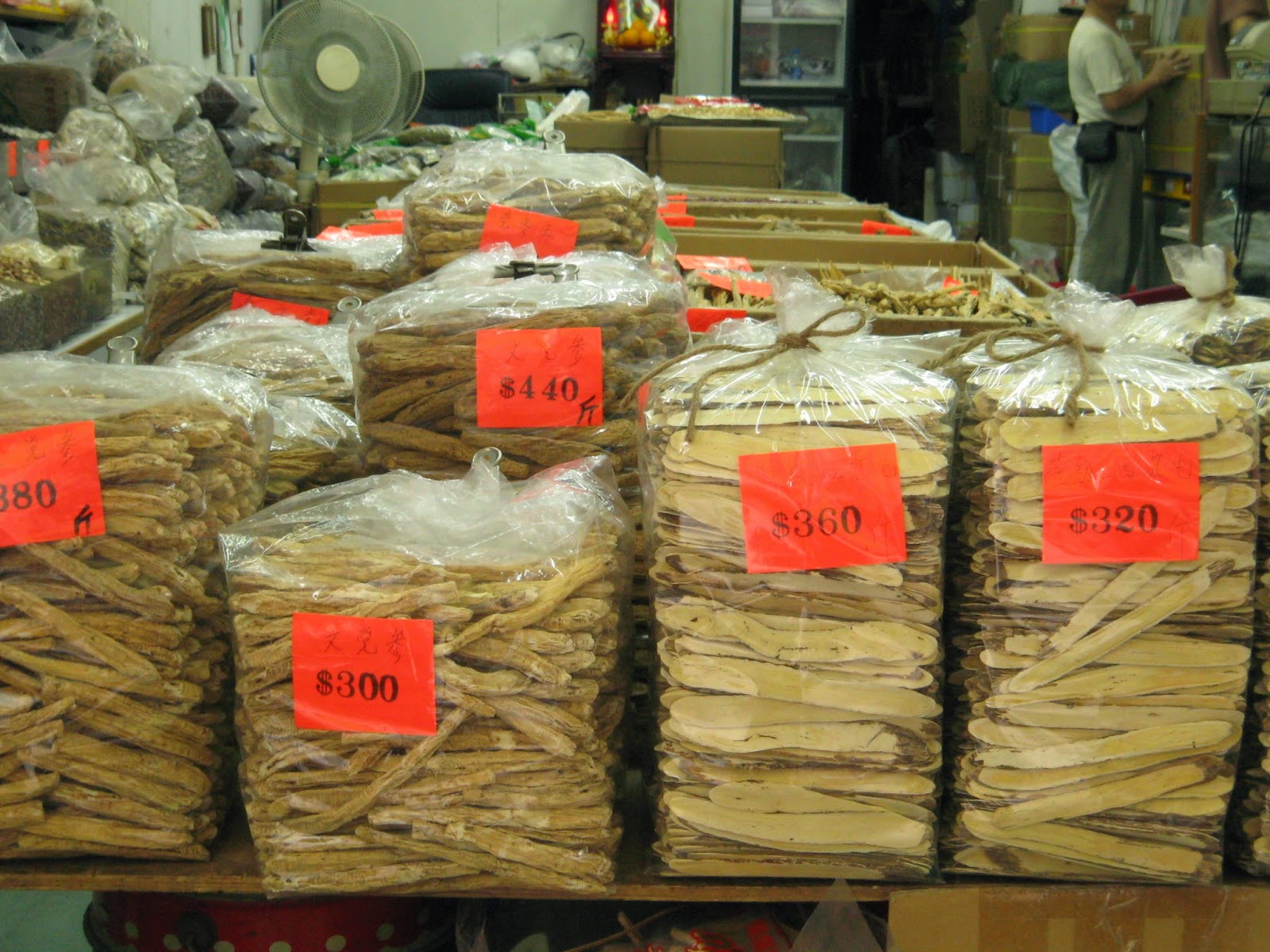
When I was booking my hotel for my four-day stay in Hong Kong, a major part of the reason I decided on one in Sheung Wan, apart from its price, was its being located amidst the famous dried seafood market in the island.  
The reviews weren't that great, from a non-Asian point of view. The main drawbacks, according to the reviews, were that the subway doesn't service the area, and the off-putting "smell" of the market.  
That trains do not reach Sheung Wan didn't bother me, as I am used to walking. And further research revealed buses and trams actually serviced the area. My hotel's website also indicated there was a free service shuttle to Hong Kong Central, where my training venue was located. 
As for the "smell," it was a minor inconvenience. I was actually jumpingly excited knowing that I will be living just beside a large - as in blocks and blocks of it! -Chinese market for four days!

And so here is a peep into it. I was a bit frustrated, because in the mornings when I left for my training the stalls were still closed, and when I arrived back in the area in the evenings they were already shuttered. So on my last day in Hong Kong, instead of visiting Kowloon, or even Macau - the ferry terminal was just across the road from my hotel - I indulged myself in a long and winding market stroll.
To say I was shocked is an understatement. I had got this picture in my head of an indoor market in a large hall, much like the public markets in the Philippines. But in Sheung Wan everything was street-side, with row upon row of market stalls along three perpendicular avenues for blocks and blocks. 

I was also imagining the din of vendors, calling to shoppers to come look at their wares, and a heap of products to dig into. But no, all things for sale were neatly and systematically arranged, inside clean stalls that didn't emit any strong smell, and the din came from only the trams and buses that passed to and fro in the adjacent streets.  
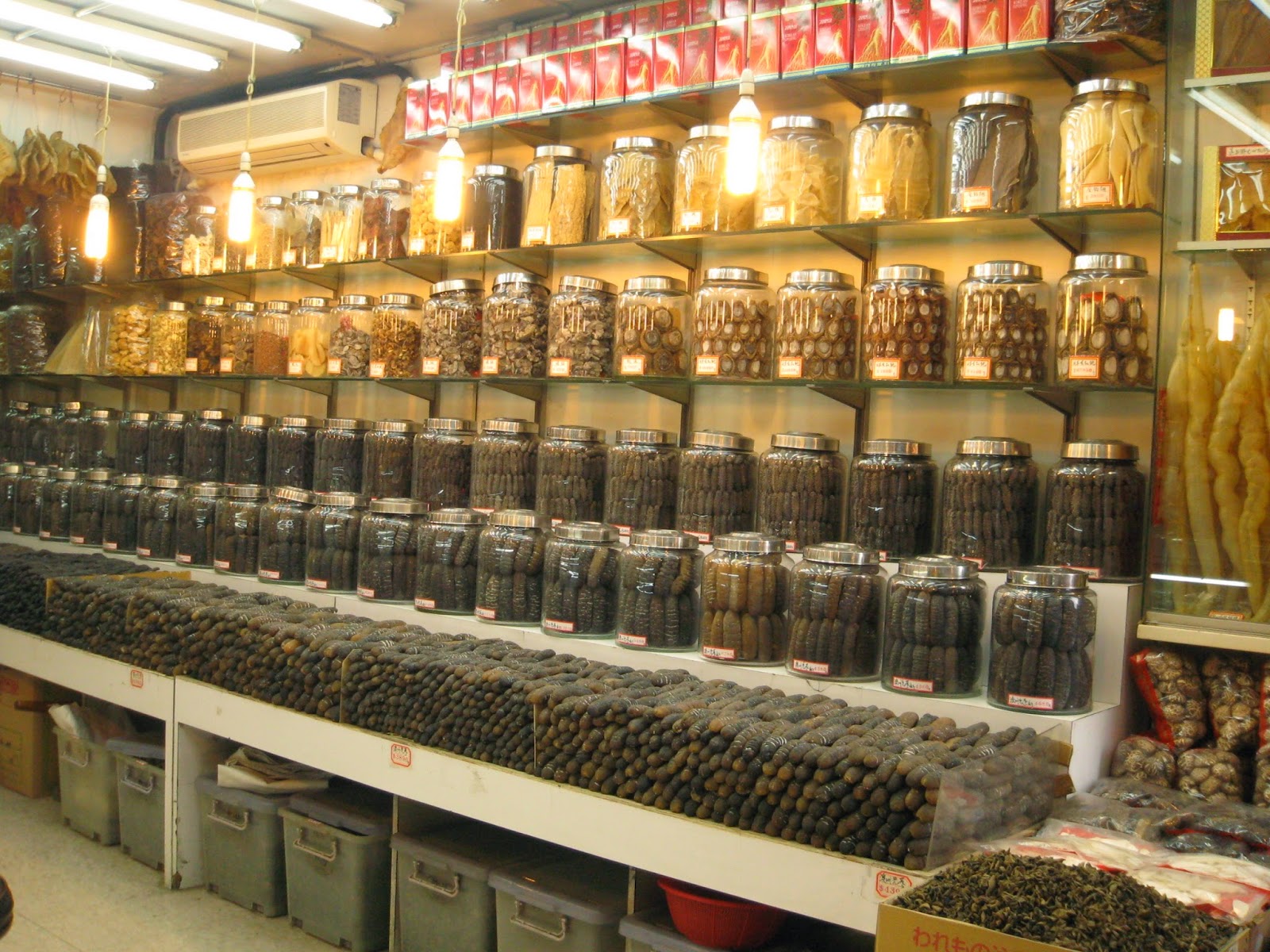
What made a lasting impression to me was the variety of sea cucumbers on sale. There were stalls solely dedicated to this Chinese delicacy, selling them in all kinds of color, size, texture. I didn't know how to distinguish one from the other, of course, so I just contented myself in soaking the sights.

Maybe like blue cheese, the moldy ones probably cost more? Or are even preferred more?
Cracklings by the sack just delivered.

I don't even know what these are for. They look like the shell I used to feed to my parakeet. 
My favorite area was the collection of stalls by a side alley selling all kinds of dried shell flesh. It was a bright place, heightened by the orangey hue of the merchandise. 
Dried scallops in varying sizes and shapes, and from different locations across the globe, made my heart skip beats. 
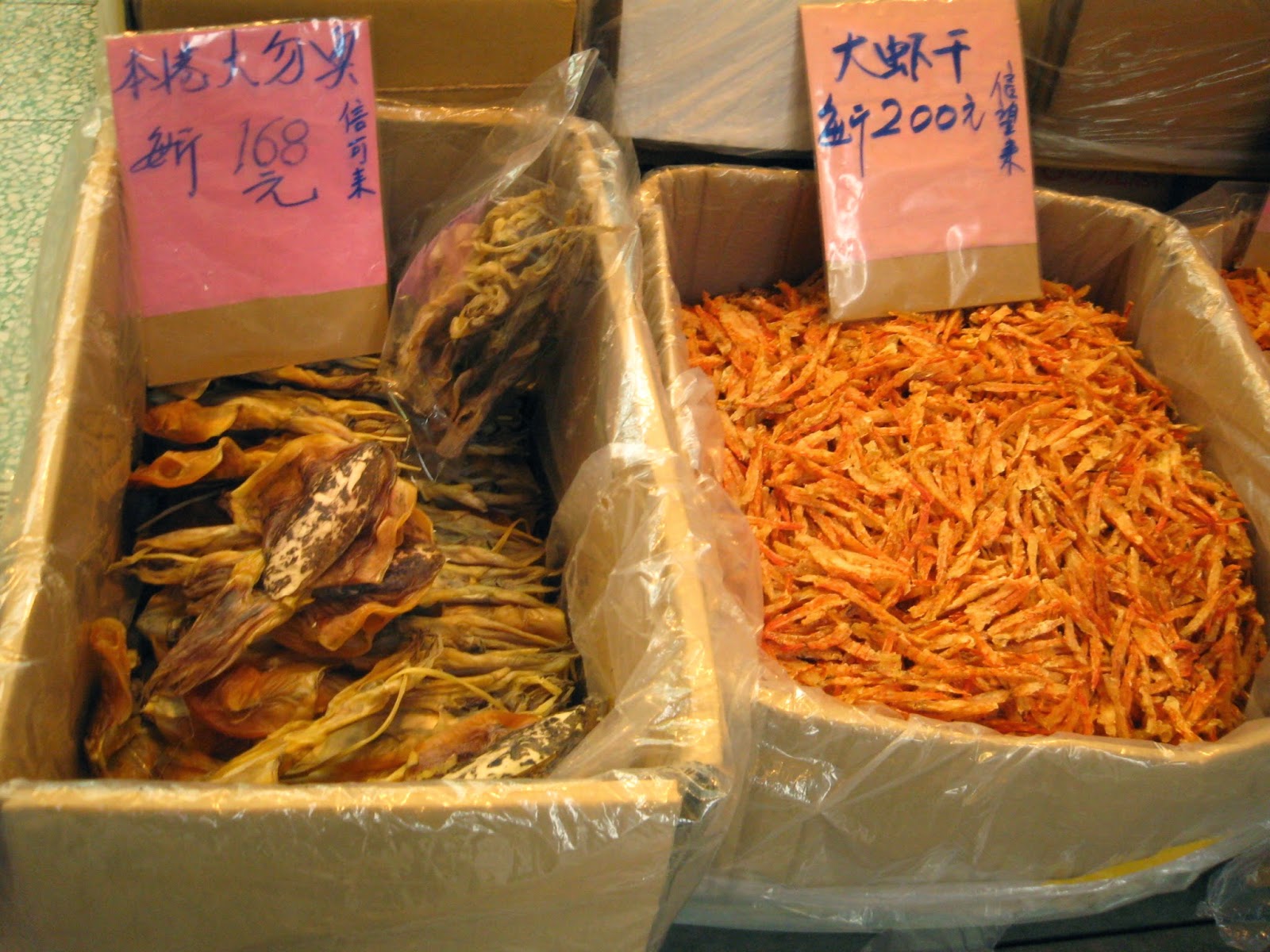
Shrimps and prawns, too, plus dried squid and octopus from miniature to giant. Fried dried squid is one of my favorite things to eat for breakfast, and I pine for the smell of grilling dried squid in the afternoons. Which is why I never thought of living outside of Asia - I cannot forsake the smell of dried squid. 
Dried jelly fish. I have never tasted one, but much as I wanted to, I didn't venture to buy. To my regret. Next time.  
More dried jellyfish, in the foreground. In the background are dried dulong, which came as a surprise. I love to eat crisp-fried daing na dulong, too, for breakfast.
Wee oysters, medium oysters, large oysters
It was truly a learning experience, going around this market. I never saw dried oysters before. In Pangasinan, as well as Cavite, we have heaps and heaps of oysters in varying sizes, but they are all sold, and eaten, fresh. Sometimes they're not even cooked at all. 
This one takes the prize for being the largest and plumpest oysters
I've seen dried seahorses in the Chinese pharmacies in Binondo (Manila Chinatown), so this was old news.  
But this one was new. I thought for a while they were scouring mats. I'd love to know how these black seaweed are eaten. 
Octopus tentacles
Fins of what fish I don't know, though I'm certain they're not from sharks
Are starfish even eaten?
The tuyo - Pinoy slang for dried salted fish - area

All is not seafood. There were strings of Chinese sausages and dried chicken drumsticks. 

Chicken intestines, too
And gizzards
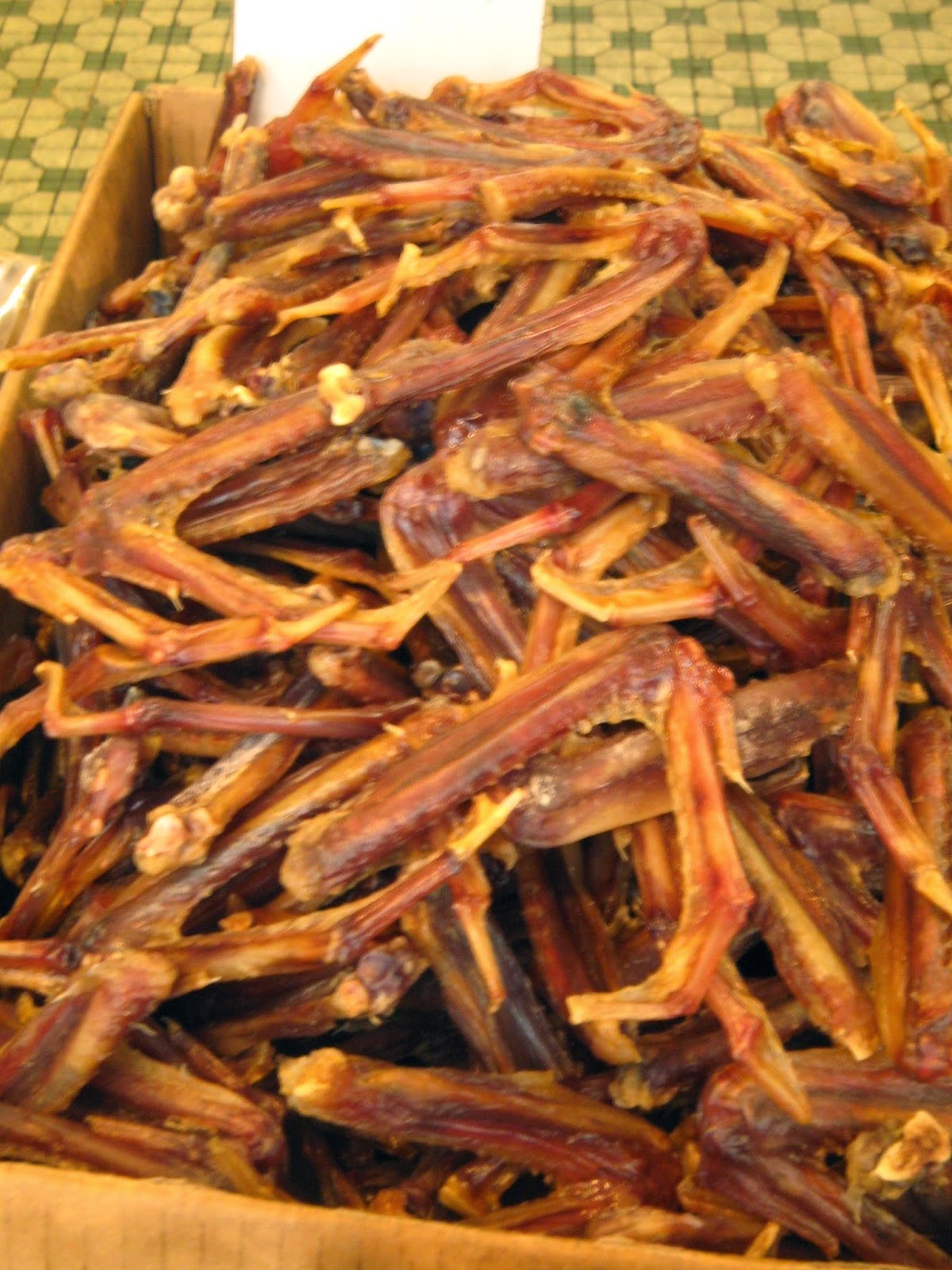
By the length of these wings, I'm guessing they're not white-leghorn. Probably not even chicken at all.
Dried noodles for the dried meats
And various kinds of teas
Dried chrysanthemum flowers. There was this coffee shop in Binondo which used to serve pots of chrysanthemum tea. I brought my friends there, and we all found the tea bitter, and it made our heads ache, but we always ordered a pot whenever we were in the area, just for kicks. Sadly the cafe doesn't serve it anymore.  

After my market stroll I got to eat this steamed atop the chicken dim sum at Lin Heung Kui.
There was one stall selling all manners of fermented vegetables.
And pickled things from the sea. 

Nuts, beans and legumes being dried under the sun along a side alley


Shopping for pasalubong

It is always an enriching experience strolling around markets. This one was so stimulating, visually and cerebrally. It was one morning well-spent, and is a highly recommended prelude to lunch at Lin Heung Kui. 

Related Posts