Showing posts with label tinapay (bread/pastries). Show all posts

Saturday, April 12, 2014

Hong Kong: Tsui Wah

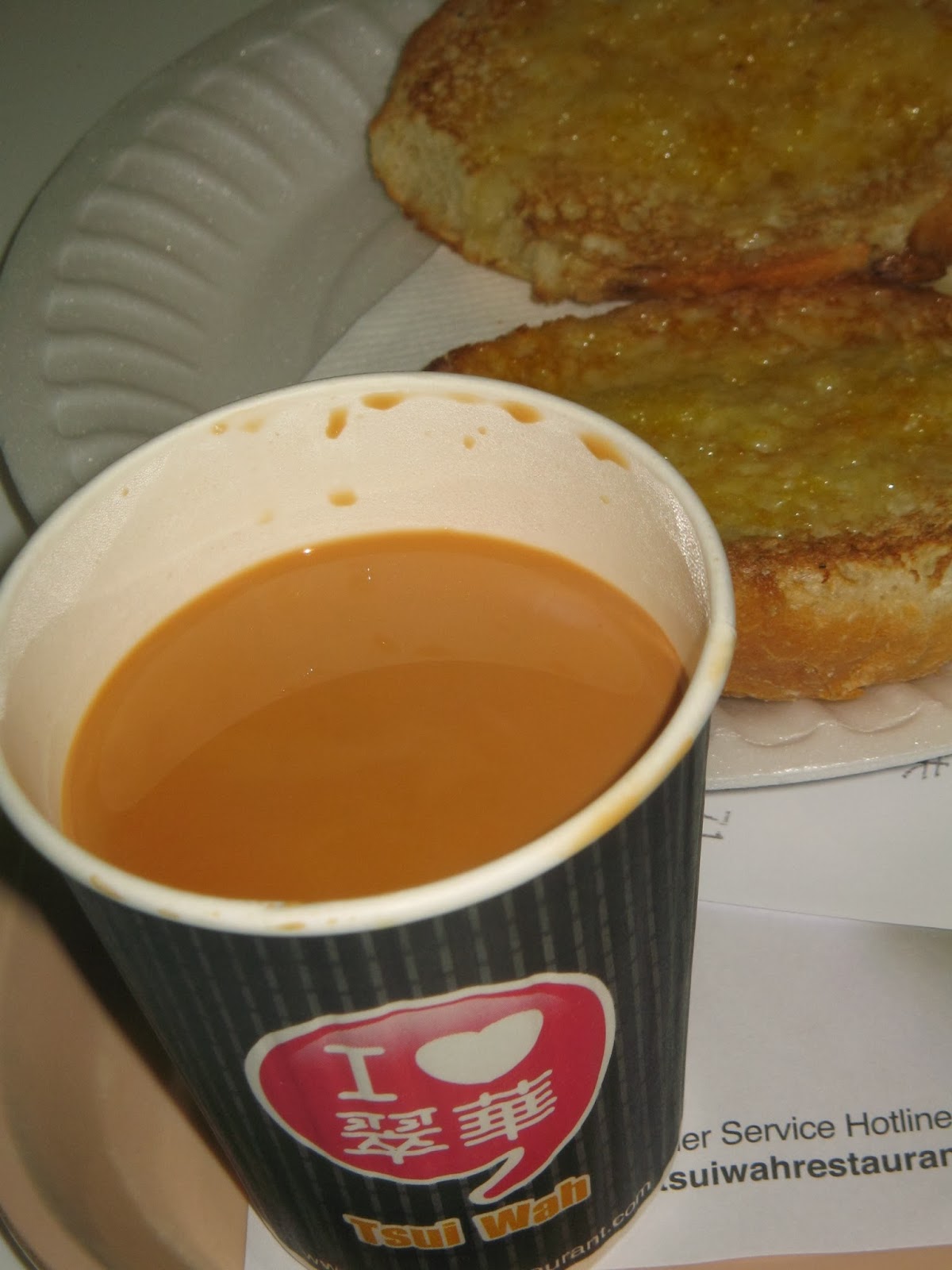
A hot cup of nai cha or milk tea and a couple pieces of sweet buttered toast from Tsui Wah, plus a bowl of fish noodle soup,  were the last things I had upon leaving Hong Kong.

Tsui Wah’s buttered toast was one of the things that made an impression on Anthony Bourdain during the Hong Kong episode of The Layover. I found the shop by the busy Des Voeux Road Central, on the other side of Connaught Road Central along which it is parallel, a large tea house all in glass walls and windows. But this must not have been the original stall that Anthony Bourdain visited, for that was just a tiny, hole-in-the-wall affair.


Anyway, trying this and that and looking for other things besides, the chance to try Tsui Wah slipped me by. But still, luck was on my side, because Tsui Wah was at the departure area of the Hong Kong airport. So I arrived early for my flight, and sat down to savor my last hour in Hong Kong with one of the city’s famous offerings. 

The nai cha was how it should be, hot, creamy and not too sweet, the full-bodied tea providing a jolt to the senses. Which reminds me – in all of the four days I traveled along the expanses of Queen’s Road Central to West, Connaught Road Central to West, and Des Vouex Road, and exploring the malls all around Central,  there was only one cold bubble milk tea shop I passed by, and that was a Gong Cha stall. 

Hot milk tea – without the bubbles – can be ordered almost anywhere, though, especially in those tiny, family-run noodle shops. And of course there were all the teahouses serving complementary hot tea to your heart’s content, but without the milk. 
But as for Tsui Wah’s buttered toast, which came slathered with condensed milk, I wasn’t too impressed. In fact upon the first bite I wondered what all the fuss was about. It was just an ordinary bun made chewy by the butter and condensed milk heating up to a slightly crackly thin layer after its stint in the oven. 

It can be easily replicated at home, using better bread and taken to a myriad of directions. With cheese? Cream cheese! Or strawberry jam. Cream cheese and strawberry jam! Or mango jam! Even just simply butter – good, salted butter – and a generous sprinkling of white sugar, grilled until the sugar crystals have almost caramelized.
My bowl of rice noodles and fish balls was bland, as expected. All three were incidentally among Tsui Wah's top ten dishes. Tsui Wah’s milk tea is sold in take-home plastic bottles, so I bought several to compensate for the tetra packs of tea and cans of creams soda in my backpack that immigration officials confiscated because I forgot to insert them into my check-in luggage. The bottles were some of the things I brought home, along with several orders of baked buns from Tim Ho Wan, and a heaping of memories of food newly discovered and rediscovered.
But before I leave Hong Kong entirely, let me include a few other photos taken at the expansive Chek Lap Kok airport. 
  The female CR must be one of the most mother- and child-friendly lavatories in the world.

No, this is not a mirror image. And with that to muse over, I boarded my plane. 


Tsui Wah Restaurant
Website


Related Posts

Thursday, March 06, 2014

Hong Kong: Tim Ho Wan

I was in Hong Kong island for a three-day training program. Half of the seminar participants were Hong Kong residents, and right in the morning of the first day, during mid-morning break, I asked the natives where an out-of-towner might eat dinner.

As it was, the training program practically took much of the day, since we ended at five o’clock daily. Meals were provided, so that it was only during dinnertime that I got to see and explore Hong Kong island. But I soon realized that there wasn’t anything much to do after five, as malls closed at six, and I wasn't motivated enough to go all the way to Kowloon for the flea markets. I decided I’d just compensate by eating.

A classmate mentioned that there was this small dim sum place inside the IFC Mall, which was within walking distance from our training venue, that was always being mobbed by people, was Michelin-starred, and served actually good food. It went by the name of Tim Ho Wan, and was located by the level of the train tracks.

I had misgivings, for I distrusted malls. I decided to check it out, anyway, thinking I’d revert to my planned itinerary if it didn’t turn out promising.
Turns out it was most promising. Turns out it was a branch of the dim sum place Anthony Bourdain raved about in The Layover episode that I watched during my flight, and which had also popped up in my research. Turns out other people don't know much of the branch, for all the times I was there I never had to wait in a queue, just directed to a vacant table or made to share one with empty chairs left.

I almost missed it, though. The sign was exclusively in Chinese, and the open façade was very nondescript, looking indistinguishable from its neighboring food shops. 

The dim sum was unparalleled, though. The baked buns with bbq pork alone was worth the trip – I wanted to eat them again for breakfast the following day. Three small siopao, the asado filling caramel-sweet and familiar, but unlike the baked siopao in the Philippines where they could be hard and dense as rocks, the baked buns evoked coffee buns with their sweet, milky melted tops and flaky, airy crumb. 
steamed beef balls with beancurd skin

I wanted to try as much as I could of the other offerings, but I was alone, which proved a handicap in my ability to get a good sampling of the menu, however short it was. I had to go back every night to try one dim sum after another. When the other restaurants in my itinerary didn’t pan out, or I couldn’t find them, I went to Tim Ho Wan.

It wasn’t a pleasant experience going around Hong Kong Central and interacting with the locals. Tram drivers, restaurant wait staff, not a lot of them could understand and speak English, and instead of looking for other people to help they would just wave their hands away.

I had the same encounter at Tim Ho Wan right on the first day I was there. They had this checklist, in Chinese and in English, where you ticked your order.  I tried to ask first what was in this dish, and for how many people it was good for, but there was the language barrier, and the server just waved me off and growled. What I couldn’t understand was that this dim sum joint was patronized by foreigners – all the days I was there half of the tables were occupied by Caucasians – but there was no effort to have at least one server who could service the non-Chinese speaking customers properly. 

But I was enamored of the food, so I was willing to overlook this shortcoming. On the following days I just ticked what sounded interesting and handed my order slip with my mouth pressed tightly closed. My instincts were probably on alert, for most of my orders were exceptionally good. That is, except for the siomai (steamed pork dumpling with shrimp), which I found to be unremarkable pitted with the good ones in the Philippines.
The lotus-leaf-wrapped glutinous rice with chicken and mushrooms was large enough for at least two people, but it was so good I finished all of it. Desserts were equally remarkable, and they were visually arresting to boot. There were these squares of jelly that recalled embroidered Chinese silk, and tasted like the aromatic interiors of Chinese temples.  
tonic medlar & petal cake

The Pinoy lelot balatong was probably descended from the Chinese dessert of red beans and glutinous rice, which was milky and sweet.


On my last day in Hong Kong I had to go back to Tim Ho Wan to buy several orders of the baked pork bun to bring home. The cashier, to whom you pay on your way out of the restaurant, uttered, “Every day!” It was probably one of the very few English words she knew, but yes, I could eat there every day.

Wandering around SM Mall of Asia a few days ago I saw a tarpaulin covering a stall under construction announcing Tim Ho Wan to be opening soon. I hope it's a branch of this revered Hong Kong favorite. I'll be waiting in anticipation, to try all the other dim sum I missed, but mostly to have a taste of those heavenly buns again. 


Tim Ho Wan
Shop 12A, Podium Level 1
IFC Mall
Hong Kong Central Station


Other Hong Kong Posts

Related Posts

Monday, June 10, 2013

Back to School

School has just opened for my kids today, and I am still suffering from birthing pains. I get nightmares even during midday naps so I have no choice but to acknowledge that I am in a panic. 

The kids were more excited than usual, though. It usually takes an ambulance siren inside the house to wake them up at 6AM, and I have to nag every second for them to start moving, but this morning the alarm went off at 5AM, and they were off to take a bath - without hot water, miraculously - while I vainly tried to go back to sleep. Even the youngest was ready to go 30 minutes before the transport service arrived.

I still have 20 pieces of long folders to cover tonight - because the pre-covered ones cost ten pesos more than the do-it-yourself - and I still have to check that all the school stuff and boxed toiletries  that have to be brought to school tomorrow for the three of them are complete according to the list the school gave out. My elder daughter has no uniform to wear as she has outgrown every piece she has and I couldn't find someone who could finish all three sets in time for today. And oh yes, I have to adjust the hook in my younger daughter's skirt, as well, as she has grown a bit, too. 

In short, I am so abashedly unprepared, so caught up was I in enjoying the freedom of not having to rush home every evening to supervise homework and reviews, that I forgot days zip by with the speed of light.  We haven't yet gone to all the museums the kids wanted to visit. And we haven't taken that 10-hour train ride to Bicol. 

And now we're here, and in the excitement of the moment I neglected to check my cellphone this morning and so I failed to see the announcement that preschoolers need not go to school today. The kid had been picked up, and I was already on my way to the office when I knew, so I just called home to say that she should be home anytime. 

After two hours she has not come home yet, and I felt like I was having an asthma attack when I couldn't get in touch with anybody at home and in school. It just so happened that I just changed my cellphone and I kept getting a wrong number when I had been dialing the correct ones. When I had figured out what I was doing wrong it turned out that a  few mothers didn't get the announcement in time either, and so the kids were allowed to socialize and play in the classroom for a couple of hours before being sent home. 

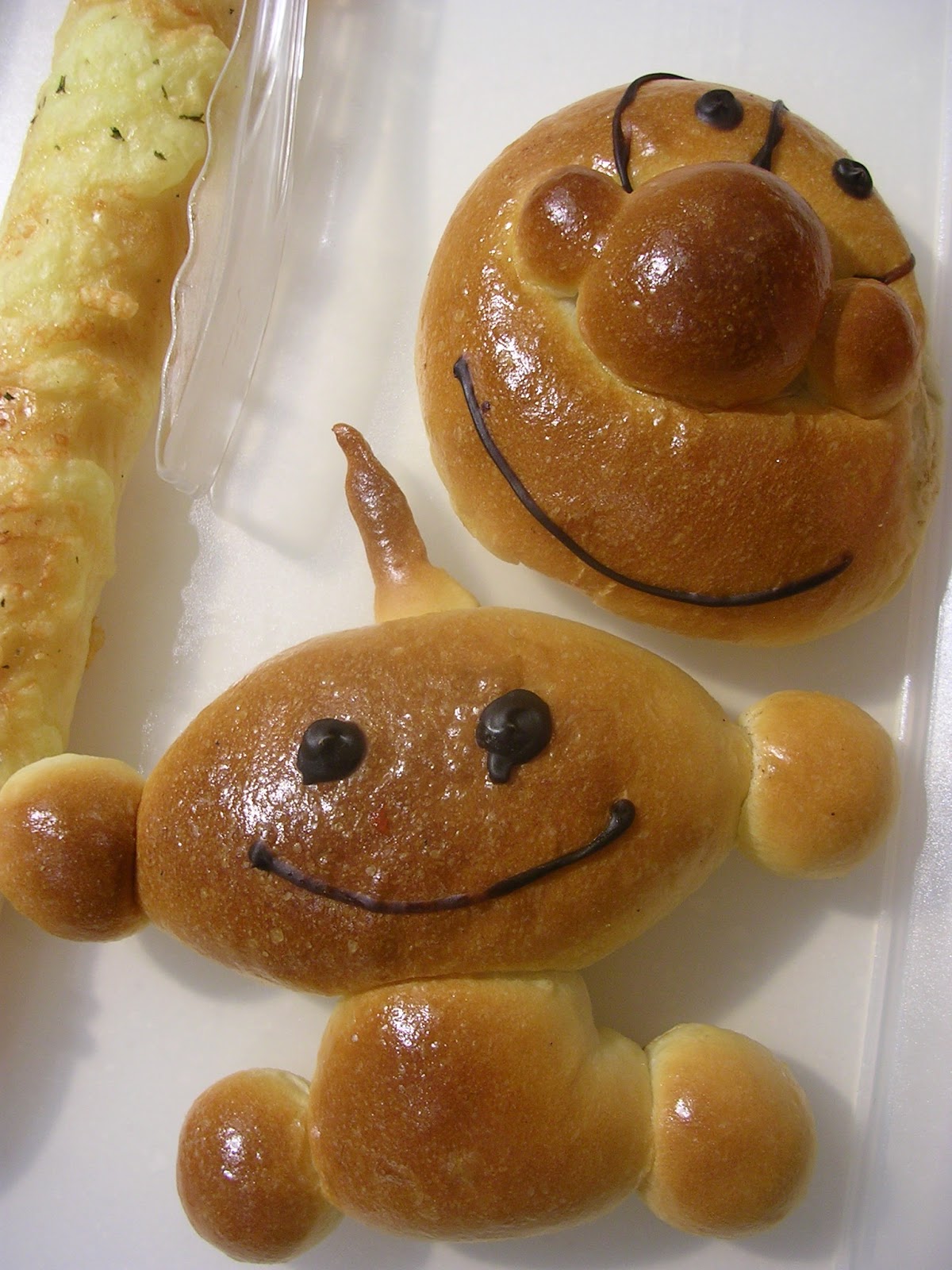
So all ends well, and I hope everything goes right tomorrow. By the rate this day went by I am going to need the Independence Day holiday on Wednesday to recuperate and locate my bearings. I am bringing home these cute pastries from Bread Talk - Mr. Beans, filled with sweetened mashed red beans, and JJ Baby, filled to the ears with chocolate - for the kids' baon, but more to bring me a little comfort and some spirit of positive thinking. I hope I can smile like they do, soon.


Related Posts 

Tuesday, January 01, 2013

Chewy Balls

 Happy New Year 2013!


*Small chewy balls of rice and flour dough, filled and topped with a variety of flavors and choice ingredients. Satistifies the requirements for sticky and round.   

Thursday, May 03, 2012

Puto Seko

 This is part of an ongoing series, "Tinapay," about local breads and cookies found in street corner bakeries across the Philippines.

I've been bringing my son on my weekly forays in the market, principally so he can watch over what I've bought gathered in a corner while I purchase other things. But there are related benefits to it, I tell him, which includes developing his arm muscles if he carries the fruits and fish. And he gets to meet what he eats in their original state.

But of course as a child he knows about the power of his index finger. It's instinctive, I think, from birth. He doesn't brag about it at home, thankfully, but he understands that I am wont to buy him anything he asks for carrying a pail of fish.

I am just glad that he asks only for little things, that most times I buy him more, and more to bring home to his sisters. And I am gladder that he is getting to discover local treats and goods, as can only be found in a provincial public market. 

Puto seko is his own market discovery, which, fortunately, is a re-discovery for me. And it became the current craze in our household.  

I hated puto seko as a child. It crumbled. It coated my hands and mouth and lap with a fine powder. But the most loathsome thing was that it was achingly, parchingly dry.  When I put it in my mouth it instantly coated my tongue and throat like a fine, dry dust. I needed at least two glasses of water to help me swallow a single piece of puto seko. It was like eating my public elementary school teachers' chalk, and recalled for me the times when I was tasked to write lessons on three panels of blackboard for my classmates to copy.

So understandably I never introduced the cookie to my kids. I never knew what attracted my son to puto seko, perhaps somebody - a relative, or someone in school - gave him some to try, but it was what he asked for one market day while perusing a stall bursting to the seams with treats like a child's dreamland. He didn't know the name,  but he pointed to it with the confident conviction that it was what he wanted.

My first impulse is always to discourage, thinking nobody would miss anything, it's not healthy, anyway, it's surely unsanitary, blah, blah, blah. But I always backtrack, and buy for the sake of experience. And mainly to expose my kids to as much of their cultural heritage, as a Filipino with an amalgamation of countless cultural groups, as possible.

This kind of puto seko (also spelled puto seco) spotted in the Cavite public market came from Nagcarlan, Laguna. I also see packets of the same dozen, small but thick discs from Binan and Calamba, also in Laguna. My son also bought similar packets at our homewtown public market in Pangasinan, but at double the price.

I mentioned it was a re-discovery for me. The puto seko of my childhood were free-formed into little fat flatish balls, or cut into squares and rectangles. My children's puto seko look like they had been shaped into thin logs and refrigerated prior to being sliced thickly.

The big difference, though, is the ease with which these present-day puto seko could be swallowed. They don't parch. They still have the characteristic dry, unyielding feel, but they are not as chalky. And they are a bit sweeter. And more solid - harder, actually. Still crumbly, but not to a fine powder.

At Php5.00 for a dozen immaculate white cookies, it beats any other snack. Of course the cookies are tiny and a kid can finish an entire pack in a single gulp. But it's artisanal, local, and a solid representation of provincial culture. Nothing can beat that.

Recipes I have come across list down cornstarch, eggs, butter and sugar as main ingredients, with some having flour taking a portion of the cornstarch. I'm not sure if these are right recipes, because most puto sekos I've tried have a distinct coconut taste. In fact, I always get a minute bit of stray grated coconut meat in the crumb.

I can't confirm the recipe for now, because I am giving my oven a wide berth  in this hot weather. In the meantime, I let my kids have their fill of market puto seko, and anticipate new discoveries.


The Tinapay Series

Friday, January 27, 2012

Chinese Weekend

gabi "babies"

It was a long weekend and several groups of family and friends were scrambling to plan where to go and what to do. I was game for anywhere and whatever, but two days before Saturday I received a text from my kids' school asking me to fetch my eldest, who was feverish. The youngest had fever the night before, too, so I tentatively informed everybody we may not be up for any trip that weekend.

Inexplicably, all plans were canceled (hopefully not because of us!), and we were left with three grounded days. Good thing there was a party to attend early Saturday morning at the Mall of Asia. And since we were already in the metropolis, and it was Chinese new year weekend, it was but a natural turn of things that we decided to go to Chinatown after the party.

ginger & pineapple "buddhas"

I thought it was still early for the crowds, but there they were, shopping for beribboned bulbs and rhizomes whose outgrowths made them look like grotesque babies. Pineapples were surrounded with tiny pineapples, or were wreathed with dalandan. Edible good luck charms.


All kinds of fruit were on sale at every street corner. Every time I am in Ongpin, the main street in Chinatown, I shop for fruits, but this time the prices were so high that we only bought a piece each of sweet, sweet honeydew and fragrant melon, both at Php120/kg. But it was nice to see the colorful spread, with pomegrenates, heart-shaped mangoes so humongous they looked like they came from Davao, passionfruit, large imported strawberries, Mayan-temple/pineapple-look-alike yellow-green fruit said to be called dragonfruit, and several varieties of plums.


There were the more common grapes, apples, orange varieties in many shapes and sizes, and there were big green balimbing that looked molar-numbing, as well as some small mangosteen that looked still out of season.

I usually go to Chinatown by way of the south gate fronting the Sta. Cruz church. This is because I have favorite restaurants in the southern half part. Last Saturday we went to Ongpin Street through the northern gate, adjacent to the Binondo church, because I wanted to try several of the restaurants in the other half of Binondo. We were only a small group - just me and three small kids - so we couldn't sit down to a proper Chinese meal, for the normal size of servings in Chinese restaurants would limit us to only one dish.


The restaurants (more like eateries) in the northern half part of Binondo tend to be small and serve a "focused" menu - specializing in one or two dishes and serving multiple variations of them. So I planned a "walking food tour" - eat a dish in one side street, then walk to another restaurant to try another dish.


We started at Dong Bei Dumplings along Yuchengco Street, an alley perpendicular to Ongpin right at the back of Binondo church. I took the kids there for some dumpling-making demo, and for a taste of dumplings not Cantonese - Dong Bei being the term for northeastern China, or Manchuria.


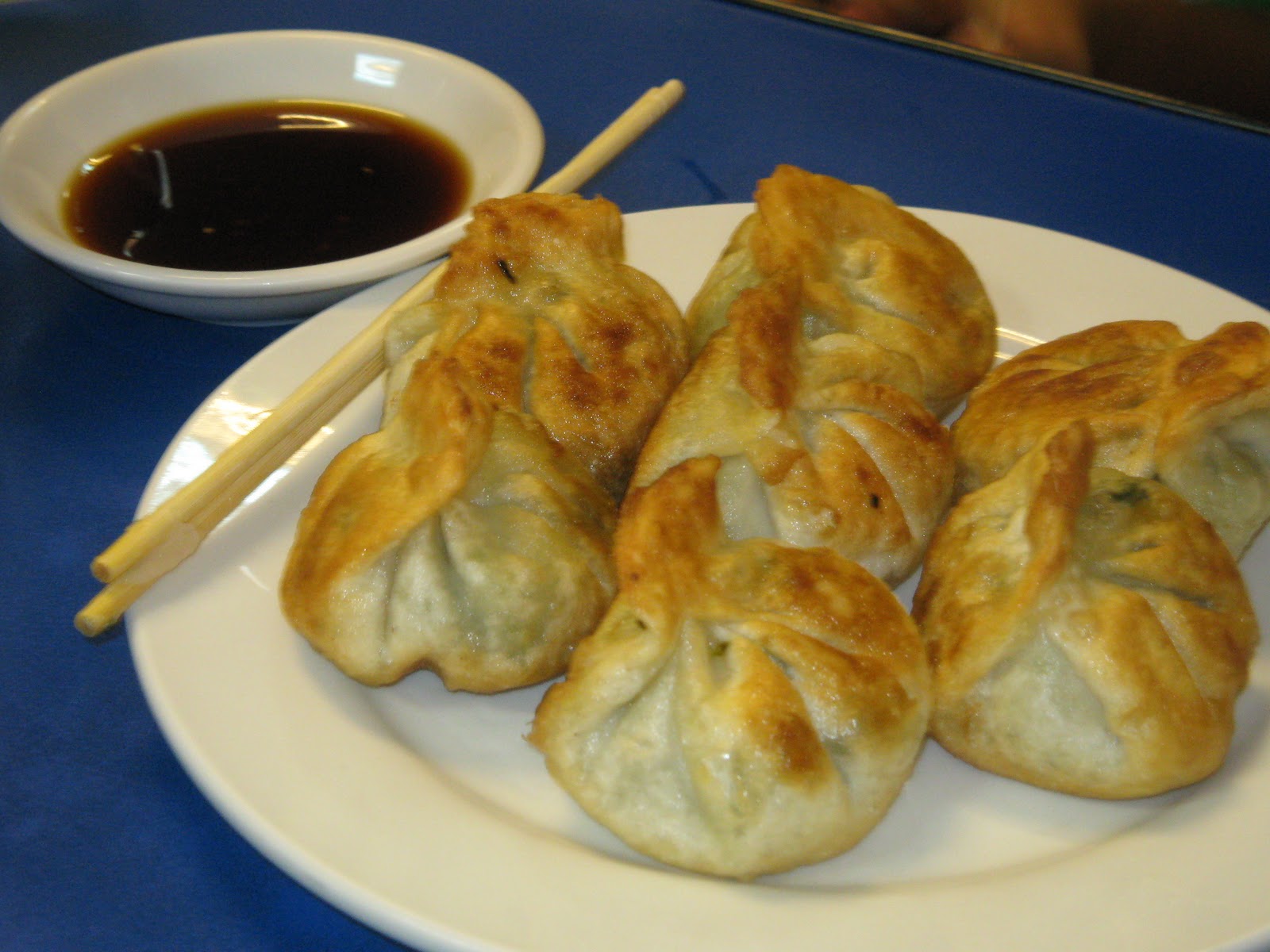
The dumplings can be ordered fried or steamed (they looked boiled, served still dripping wet). The fillings of all kinds of dumplings had minced kuchay and leeks, which were being stripped and sliced at the tiny kitchen as we ate. So no, we weren't crying because the dumplings were so good, but because the leeks hurt our eyes.

But yes, the dumplings were great - the fresh, thin made-to-order wrappers cooked just so they were soft but still had bite, and the dipping sauce was black vinegar spiced with chopped onions.


We had an order of xiao long bao, pork dumplings with a pocket of broth, which were good, though Lutong Macau's version is tastier and firmer. It was amazing, though, how everything looked the same from when I first ate at Dong Bei some five years ago. It's like time stopped. Same people (the proprietor-cook even looked the same!), same five tables, two of which were occupied by dumpling ingredients and paraphernalia, same set-up, even the same freezer and kitchen equipment.


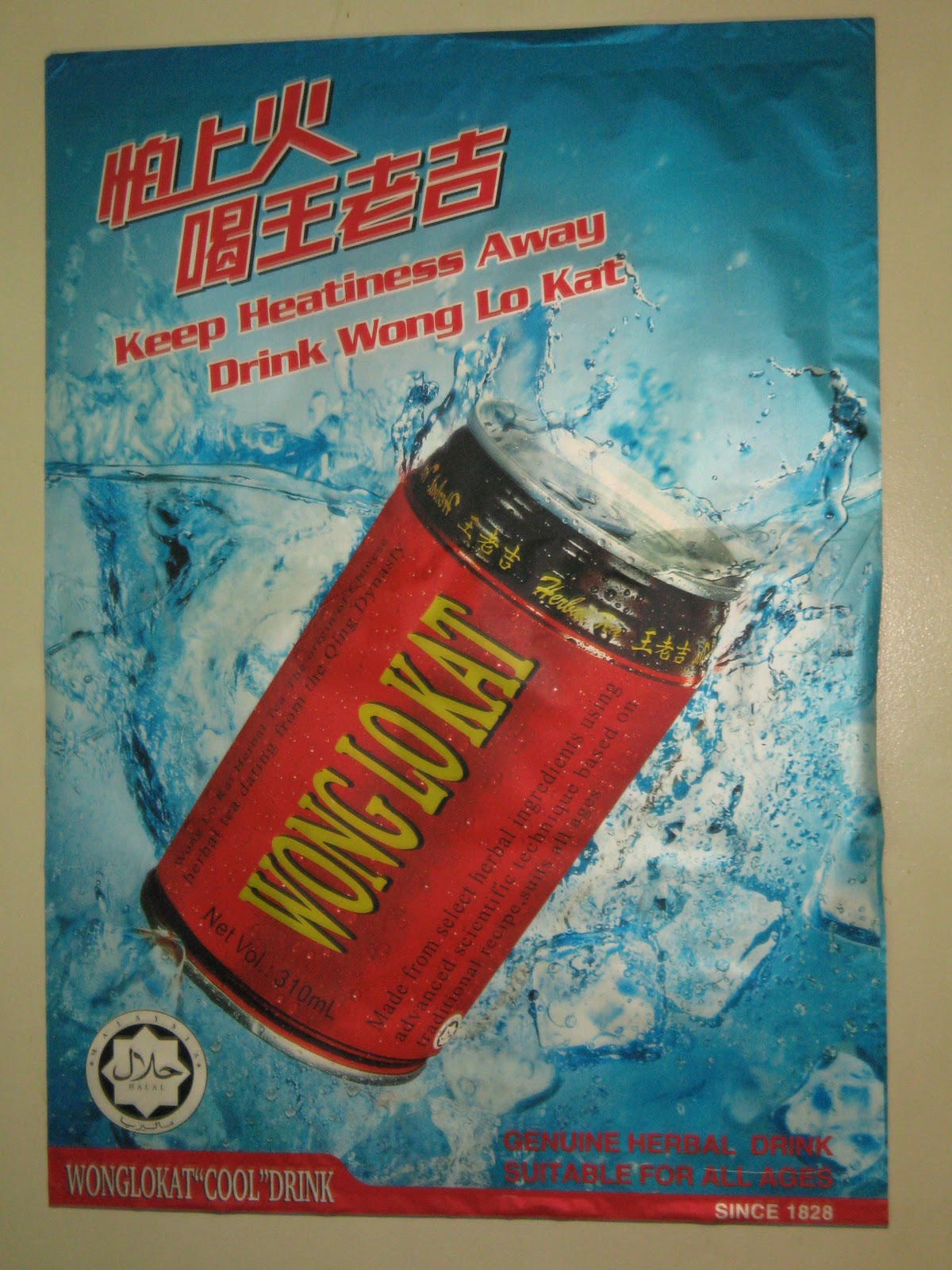
There was a chiller by the glass front with cans of soda, and this iced tea. It purportedly is a "cool" drink, because it keeps away "heatiness." It was good with the dumplings, tasting exactly like sweetened Chinese green tea (the one in tea bags in jumbo green boxes). The kids said the taste vaguely resembled sago't gulaman with a certain moldy edge to it. They downed three cans, and were cool to go to another dumpling house.


We walked back to Ongpin to take in more of the sights and partake of the air of revelry. There were groups of teens doing the dragon and lion dances, and we crossed paths several times with Ivan Man Dy's walking tour group. We peeked in at the stalls by the estero and espied frog legs, but nothing more exotic was on display, so we proceeded to Salazar Street.

Leading off perpendicularly from Salazar was Benavidez Street, and just several stalls into the alley was this small eatery with red Chinese signage in front and no English translation. It was beside Wai Ying Roasts, and it was what we were hunting for, for another round of dumplings.


Binondo denizens swear the dumplings here are better than at Dong Bei's. The wrappers are thinner, shaped into pockets unlike Dong Bei's which were pressed crescents. They had the same filling of finely ground pork mixed with kuchay, but the dumplings are slightly bigger. One serving has about sixteen dumplings, and the staff who waited on us suggested that we have half of the serving fried, the other half steamed.


The dipping sauce is served along with the dumplings. But a host of other condiments is present in every table, for the noodles. For this is actually a noodle house, the Chinese signage meaning Lan Zhou La Mien, as indicated in the t-shirts of the servers, la mien translating to hand-pulled noodles.

The condiments were akin to a Vietnamese pho house - bowls of sliced spring onion, chopped wansuy (cilantro or coriander), several different bottles of chili sauce, chili powder, black vinegar.

Above the clear glass wall encasing the kitchen were blown-up photos of the house specialties - noodles with a variety of toppings, plus the dumplings. We were told the beef la mien showcases best the capabilities of the kitchen, and beef la mien it was for us.

From our table, which was just a table away from the kitchen, we witnessed the manipulations of the cook pulling on a hunk of dough. The kids asked if they served pizza, because there were a lot of dough-tossing and turning like in a proper Italian pizzeria. A minute later, though, the enormous slab of dough magically transformed into strands after much fast pulling and pulling and pulling.


Kids: Is that dough?
Mommy: Yes.
Kids: Can we eat it?
Mommy: Yes, of course.
Kids: Why can't we eat our play dough at home?
Mommy: Let's see you try pulling it into noodles.

But frankly, the beef noodle soup was the best we've ever had. The soup spoke of hours of boiling meat and bones, with not a hint of broth cubes or bouillon, nor a ton of flavor enhancers. I think it was perfect as it is, flavorsome as it was. I snobbed all the condiments on the table and ate it as it was served. There was no need to add anything.

And the noodles - the noodles were an incredible revelation. Soft and spongy, yet possessing a firm bite, and had an unexpected rich flavor. I once swore off hand-pulled noodles because the one I tried one time in a mall was so bland it made the commercially packaged dried egg noodles sold in supermarkets ambrosial in comparison. But Lan Zhou La Mien redefined what a bowl of noodle soup should be. I cannot be satisfied with anything less from now on.


We walked back again to Ongpin, our stomachs full of dumplings and noodles, debating if we could eat some more, as we still had a couple more restaurants in our itinerary. We decided to wait for sundown, and not to order rice.

But we passed by Lord Stowe's, and I couldn't help myself, seeing as the stall was not so crowded and there were some vacant seats. We gave our legs and feet a much needed respite from all the walking while sipping Japanese iced tea and waiting for the egg tarts to bake.

After all the dumplings and noodles it was nice to munch on something sweet, and a freshly baked, piping hot tart with an almost runny custard just hit the spot.  


The multiple lines snaking out of the three Eng Bee Tin stores along Ongpin weren't getting any shorter, but it was already getting dark, so we fell in line ourselves before all the shops closed. I held my place in the line while the kids got as much hopia and tikoy as they wanted and carried them to my basket.


mocha hopia

I grabbed what I could reach as the line moved ahead, and I got the new hopia varieties as well as the standard ones. Store crew kept stocking the shelves but the hopia kept disappearing. Basic flavors red mongo (premium), yellow mongo and ube were in stock, but there was no pandan and our favorite combi (combination), ube-queso and ube-langka that day.

The new variants were more than enough to keep me happy, though. Mocha, super premium, mochipia - how much more adventurous can you get? Biting into the new flavor mocha hopia was like biting into a thick, velvety cup of coffee.

super premium hopia 

This is the super premium mongo. I like the premium mongo best of all the basic hopia flavors, which uses red mongo. This new variant uses yellow mongo with the yolk of an itlog na maalat (salted duck egg) inserted in the middle. The saltiness of the duck egg was unusual and unexpected in a hopia, but not unpleasant. The flavor combination, and the fine silkiness of the yellow mongo calls to mind a lotus mooncake with egg yolk.

mochipia
I like Eng Bee Tin hopias, and they are the best in terms of quality among all hopia in the country today. I can't say I like them best, though, for I find the filling a little bit too much - the filling-crust ratio is not well-balanced. But I am rethinking this, because Eng Bee Tin has come out with its mochipia line, and it has solved the thickness issue for me.

The mochipia is mochi and hopia rolled into one. Mochi is filled tikoy balls (ground glutinous rice flour shaped into spheres with a paste filling in the middle), while hopia has a flaky flour crust and a paste filling. Combine the two, reversing the mochi so that the rice flour is inside and the filling outside, then use that as the filling for hopia, and it becomes mochipia.

There's a play of textures here - sticky tikoy, silky paste filling, flaky crust. It teases the mind as well as the senses. Whay hasn't Eng Bee Tin thought of this sooner? Now I don't think the filling is over-indulgent. Now I can't get enough of mochipia.

The mochipia flavors available last weekend were ube macapuno, which is tikoy inside an ube hopia, and buko pandan-ube, which is pandan hopia filled with ube tikoy.

hoptik


Before we went to Chinatown we had been enjoying SM bakeries' hoptik, which pretty much had the same idea as the mochipia. The hoptik had tikoy as the core, surrounded by bean paste, then encased in a much more flakier crust. The hoptik has a thinner filling, which isn't as fine-ground as Eng Bee Tin's. But it's enjoyable, too, because the tikoy is thick, and the textures scintillate. In yellow mongo, red mongo, and ube flavors.


The kids love Eng Bee Tin's tikoy rolls. We didn't bother with the Chinese tikoy - those thick  slabs in boxes that have to be fried before eating - but the kids each got ten packs of tikoy rolls, two of each flavor (ordinary, pandan, sesame, strawberry, ube).


Tikoy rolls are ground glutinous rice (malagkit) filled with kamote (sweet potato) or yellow mongo paste and shaped into rolls. The malagkit is flavored with strawberry, ube, pandan, or coated with sesame seeds. They are soft and chewy, and are perfect snacks to bring to school, but the rice flour in which they are rolled to prevent sticking can make a little mess. 

By the time we came up to the cashier and completed our purchase the restaurants on our itinerary had closed. But we were satiated, and we had enough hopia and tikoy to last us a month, so we called it a day. Other Chinese delights could wait, and we promised to come back at a calmer time, proceeding at a more calmer pace so we could eat more. But these ones we're eating again, for sure.  


Dong Bei Dumplings
Yuchengco Street, Binondo, Manila

Lan Zhou La Mien
818 Benavidez Street, Binondo, Manila

Eng Bee Tin
628 Ongpin Street, Binondo, Manila
Website


Related Posts
Quezon Tikoy
Bibingkoy
Mochi of Pampanga

Tikoy Recipes
Baked Buchi
Masikoy
Home-Made Buchi
Kulambo
Home-Made Tikoy


Monday, January 16, 2012

Ensaymada

This is part of an ongoing series, "Tinapay," about local breads found in street corner bakeries across the Philippines.

To me, ensaymada is to tsokolate as the pestle is to the mortar, the chef's knife to the chopping board, salt is to pepper. One's function ceases to exist without the other.

My mother disagreed. A heavenly breakfast to her is a cup of hot tsokolate with suman and ripe mangoes. But I'm a generation down the line, and while I adore suman, I prefer to be chewing on something more insubstantial while imbibing my favorite hot drink. It was my father who introduced me to baked goods and pastries, after all.

I had wanted to write about ensayamada the moment I started this blog. Like all Filipinos, and citizens of other former Hispanic colonies, I am passionate about the pastry. How can anyone not be, when ensaymada in various shapes, sizes, textures, degrees of sweetness, and whether cheesed, buttered, or sugared, exist in every street corner across the country, from the small-time home-town bakery to the most expensive bakeshops in hotels and specialty restaurants?

I have seen balikbayans' eyes glaze over upon seeing a plate of ensaymada. My uncle, after an unbelievable 24-hour flight from New York, declined every sort of food I could think of to offer, but he suddenly brightened up after I said the magic word, and accepted a warmed piece.

When I was growing up I was content to take nice little nibbles on our hometown bakery ensaymada. It had a coiled, slightly underbaked dough, yellow with eggs, slathered on top with margarine, and pressed with sugar. But I went to Metro Manila for college, and I encountered ensaymada made like fairy wings - fluffy and soft, airy but buttery. And topped with grated queso de bola! But there were hometown-style ensaymadas, too, which I also found in the other cities and towns across the Philippines.

Over the years I had been compiling in my mind my "best ensaymada list." But every year I revise it. Some, like the one served at Seattle's Best when the chain first opened in the country, have disappeared. Others have deteriorated in quality. My ultimate best used to be that of Merced's, then Mary Grace Kitchen's.

Because I have already written about my chocolate drinks favorites, I'm going to proceed with my ensaymada list, as well, this year. I won't claim that these are the best in town. Rather these are my favorite ensaymada from all the ensaymadas I have come across.

The list leans towards Metro Manila and northern Luzon because of proximity, and provide a sample of the wide spectrum an ensaymada can be. They are all worth - actually more than - what you pay for, too. I hope to add more to the list as I encounter ones that imbed themselves in my memory.

One thing is for sure - all ensaymada get better with a short stint in the toaster, eaten hot with all the melted cheese and butter. And with a hot chocolate drink, of course. These ensaymada, which I never get tired of eating, are all these - they're fluffy beyond belief but still substantial. Not one sports a crown of cream - just butter and cheese for me, and maybe some sugar. And baked right, not toasted nor underdone.

  • Hizon's (top photo) - one of the most expensive, and among the biggest ensaymadas commercially available. Everything about it - the fluffiness, just the right amount of cheese and butter, not so sweet, and how it toasts well, is what I like in an ensaymada. I like both the cheddar and queso de bola variants.

  • Hizon's Cakes & Pastries Facebook Php90-95 small, Php115-120 large


  • Cara Mia's Parmesan Ensaymada - this was an absolute favorite, a unique ensaymada topped with cheese beloved in Italy. It went out of production sometime in 2010, but I was rejoiced to find it's back - in limited quantities - since Christmas of last year.

    The new version is soft - so soft it wasn't recognized as ensaymada by my kids. I brought home a box, and noticed the following day that it was gone. I asked where the ensaymada was, and the kids replied what ensaymada? I thought they were feigning innocence that stemmed from guilt because they had consumed the entire box. After much hemming and hawing from me, their eyes suddenly lighted up and they exclaimed ah, that? Was that ensaymada? We thought they were mamon!


  • Cara Mia Gelateria by Amici
    Facebook

    • Pinkie's - at Php10 per piece, the best value for money ensaymada. The quality and taste are largely disproportionate to its tag price, and I always get the feeling that I've gotten more than what I paid for when I buy dozens of this (don't we all love feeling that way?). With the hometown, rustic feel, not airy and fluffy, but substantial and bready, yet so soft. The mamon is excellent, too.

    • Pinkie's Perez Boulevard, Dagupan City, Pangasinan beside Victory Liner/Five Star bus terminals

    • NE's Ube Ensaymada - ensaymadas have evolved to be in different variants, mostly ube, also monggo, but also in chocolate, even with bacon and ham. NE, a roadside restaurant in Cabanatuan City offering specialties of Nueva Ecija, makes an impossibly soft ensaymada platter coiled with ube dough. The ube dough tastes like it's been made with real ube, and the purple yam pairs so well with the rest of the buttery dough sprinkled with thin slivers of cheddar cheese.

    • NE Cakes & Restaurant Maharlika Highway & Lakewood City Cabanatuan City, Nueva Ecija Facebook
    • Chef Laudico's BFAST QDB Ensaymada - small but dense and not so fluffy, this is almost like bread, but still soft and buttery. Order with it the Belgian hot chocolate.

      I almost missed this - it looked hard as stone sitting there in BFAST's display case. But it was offered one time in the lunch and dinner buffet, and I tried a quarter. I couldn't help but demolish the entire tray of it that day, and the waiters remember me for it.

      Don't worry about the sparse sprinkling of cheese on top. The rest had been tucked inside.

    • Chef Laudico's BFAST Ayala Triangle Gardens Makati City Php98 per piece
    • Good Shepherd - how can you resist that mound of cheese? And the soft, chewy crumb? Not so eggy and buttery, but fluffy enough, soft enough, and sweet enough. It's serenity nibbling on this ensaymada in the cold highland atmosphere, while the dewy mountains shimmer in the distance.

    • Mountain Maid Training Center Good Shepherd Convent 15 Gibraltar Road, Baguio City Website Php40 per piece
      • Pan de Manila's Special Ensaymada - topped with flakes of the now ubiquitous queso de bola (here almost melted after toasting), this is so cheesy it is almost savory. I find I am wanting a little sugar while eating this, because I am so used to a sweet dimension to my ensaymada. It pairs well with pasta, and even stews and roasts. Large beyond usual, and siksik. At Php40 each.

      • Pan de Manila Website
    The Tinapay Series