Showing posts with label pancit (noodles). Show all posts

Sunday, April 16, 2017

Pancit En Su Tinta Choku

Bernie's

This pancit - stir-fried noodles - has been featured countless times in Philippine published media and television programs that I may not have anything more interesting to say about it.

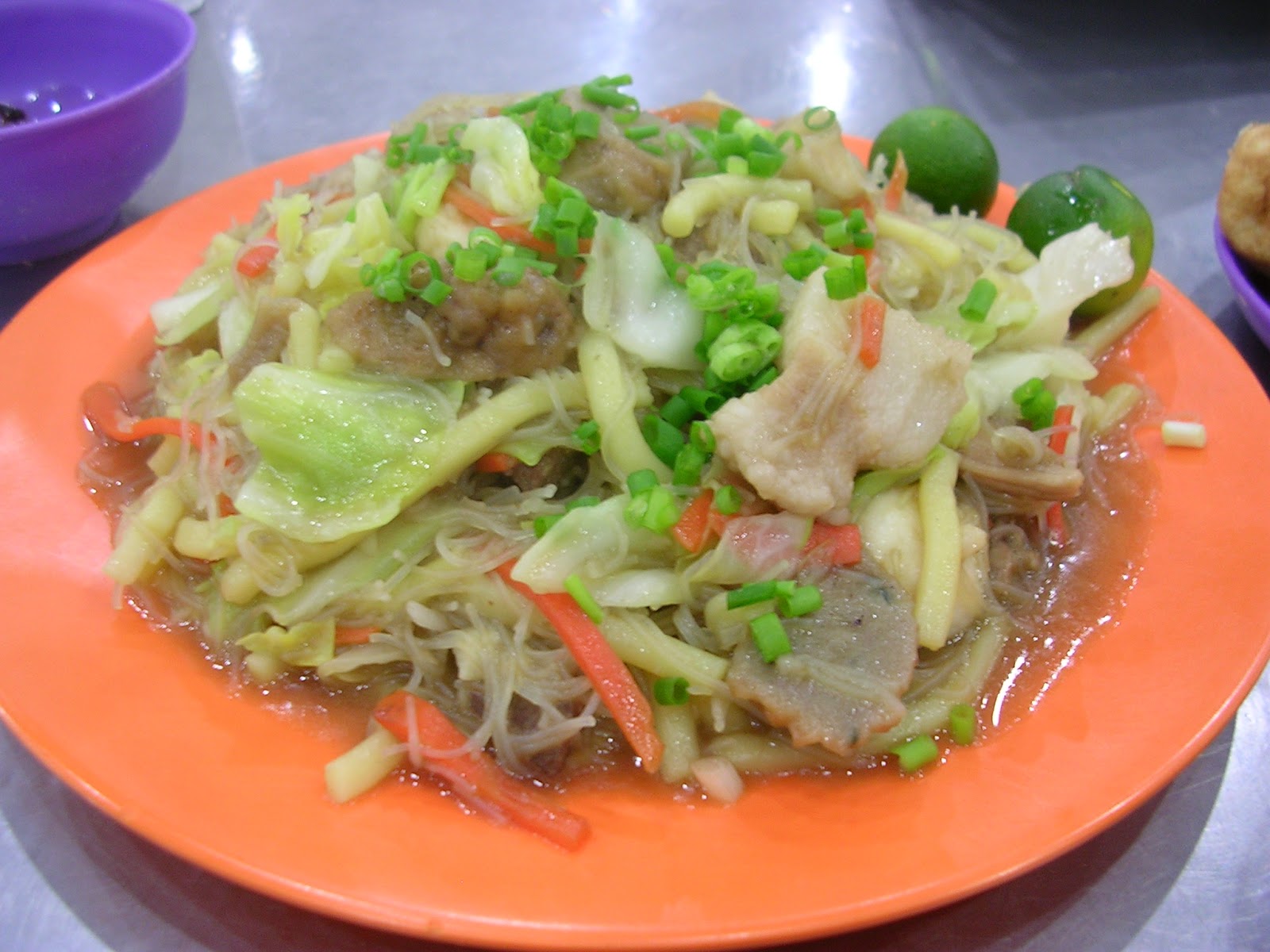
For those who have come across this only now, this is pancit dyed and flavored with squid ink and soft slices of squid, then topped with fried garlic bits, crushed chicharon, spring onions, and sliced kamias as the souring agent instead of kalamansi. The name means stick noodles in squid ink, from the pidgin Spanish spoken in Cavite City by old-timers.

For those who have read about it and/or come across it on TV, I have news. Asiong's Carinderia, the Cavite City eatery which invented and first sold this dish, closed shop several years ago. A new carinderia, however, has opened its doors and serves almost the exact same menu as Asiong's, including pancit choku, which is referred to as pancit pusit in the menu board behind the display counter. The photo above is the pancit pusit at Bernie's Kitchenette, whose staff told me is owned by a chef friend of  Sonny Lua, Asiong's proprietor. The same staff also told me that Sonny now lives in Silang, Cavite, and has set up a new Asiong's Carinderia there, but that the cook/s at Bernie's are the same as the one/s who used to cook for Asiong's. 

The pancit pusit tasted the same as pancit choku, only that instead of kamias the souring agent used is shredded green mangoes. The carinderia had run out of green mangoes when we ordered, so we were given kalamansi, which I supplemented with the very nice spiced vinegar that's also being sold at the store.

The pancit came to mind because as the kids and I were on our annual  Bisita Iglesia, an officemate called  to ask where she could find the black pancit. I was struck by the term as it was then Black Saturday, more so that we had decided to wear black shirts this year on our pilgrimage. After our survey of six churches in the highlands of Cavite, we decided to push the color motif further and went to Bernie's, to eat black pancit. We deemed it appropriate Lent fare, without meat (we chose to ignore the chicharon which wasn't meat, per se), particularly now that my eldest child is of eligible age for fasting and abstinence. 

Photo of Asiong's pancit choku, with chili garlic in oil, taken five years ago.


Related Post:
Home-Cooked Pancit Negra

Wednesday, May 14, 2014

Japan: Rokurinsha

My arrival in Tokyo was a protracted one, despite being on an on-time, 3-hour direct morning flight. I dutifully went to the airport a full four hours before the ETD, which meant I had to leave home around 2AM. As usual I had not slept doing last-minute checks, and I had failed to expect that the budget airline I had chosen to take me to Japan had seats that did not recline (I am never taking a flight with this airline again).

I had known that all food on board was for sale, so I had brought along lunch (no breakfast for me, I had flown from NAIA 1, and all dining outlets there look suspect). But it had been horrible to hear the announcement a few minutes  after we had taken off that consumption of food brought in from outside was not allowed on the flight. Good thing I had a window seat, so I managed to eat on the sly the chicken pie I had bought the day before from Banapple. 
Anyway, I was at the Narita airport after lunch, and after managing my way around the terminal and withdrawing enough local currency from an ATM, I boarded a bus direct to the heart of Tokyo. The bus ride took approximately an hour, then I spent another 30 minutes or so walking to my hotel, which wasn’t all that far, but I took my time ogling at all the window displays and then some.

And so by the time I had deposited my things, freshened up, and changed clothes, it was close to four o’clock in the afternoon, which meant I had about thirty minutes of daylight left. I had planned on going to Shibuya on my first day in Tokyo, to have a photo taken with Hachiko to fulfill the promise I had made to the kids. So I hurried to the Tokyo train station, which was a ten minute walk away.  
at past four on a Monday afternoon

While I tried to locate the right ticket booth, I chanced  upon this long line of people clad in what looked to me to be office attire, each one toting a briefcase of some sort. I wondered what were office workers doing out queuing to eat at that time of day? Did office days end early in Japan?  But the most important thing I hadn’t known at the time was that I had come upon ramen alley at the basement of Tokyo station by mistake.

My trip to Japan was for eight days, but this time I did not search every nook and cranny of the internet looking for recommendations on where to eat. This was because Japan was known all over to be an expensive destination, and if I find recommendations to places that turn out to have unreasonable prices, I’ll just be disappointed for the length of my trip. So I decided that I’ll eat wherever I find myself during mealtimes.

It wasn’t mealtime at past four, but seeing that long line made my stomach growl, out loud, and I instantly remembered, and felt, that I haven’t had a decent meal since the previous day.  So I decided Hachiko wasn’t going anywhere and could wait for my visit on another day, and promptly fell in line, which at the moment hadn’t turned the corner yet.  I hadn’t known it then, but I just fell in line for the second most famous tsukemen in all of Japan, and that people queue for it for hours in snaking lines.

I didn’t even know what the shop was called, as the sign did not have an English subtitle, or what it sold. But the line moved briskly enough, and I was able to peer in through the windows, seeing that people were slurping on what looked like udon. I thought it was perfect, that I'd get to eat a hot bowl of noodles on my first day in cold Japan.

Soon, in under twenty minutes, I was able to peek at what’s going on at the end of the line. There was this good-looking usher who asks how many persons for a table, guides the first ones in line to the ticket vending machine, on to the available table, then  comes back to repeat the process.

At around seven on a weekend morning 

I was able to make out the prices at the vending machine from my vantage point, but because my head was floating from lack of sleep and proper nourishment I was getting mixed up in converting the prices to Philippine peso, so that they came across as out of my league. I didn’t think of leaving, so near the end of the line, so I thought I’ll just get the cheapest bowl of noodles, and make up for the splurge by spending only so much the following day.

But when it was my turn the usher smiled, and in perfect English declared that the special recommendation was this one, pointing to the slot in the vending machine with the photo and price of the most expensive bowl, which I now know to be called tokusei tsukemen. That usher may have been a charmer, for no matter how rock-solid my resolve was a minute before, I inserted my money into the slot he pointed to.

I was seated at the bar – first-timer’s luck is luck ten-fold – where I could stare, fascinated, at the cooks strutting their stuff. The individuals seated around the bar were all males, with age range of late twenties to about the  fifties. The younger ones were taking photos with their phones as their bowls were handed to them.

The first thing to land before me was a paper apron, followed shortly by my expensive noodles. It turned out to be tsukemen, the massive current Japanese rage, almost  a deconstruction of the ramen  – broad, firm ramen served cold and dry, with an accompanying bowl of thick soup for dipping. Tsuke in Nihonggo is "dip," while the men refers to the noodles, thus tsuke-men. 

The JPY1,050 price tag had been due to the contents of the soup – everything that could be put on it as topping was there – the iconic slice of kamaboko (pink-spiraled fishball), buta hogushi (shredded pork), a square of nori (seaweed), on top of which is a special house blend of bonito powder, negi (chopped spring onion), and deep down at the bottom of the bronzed soup were memma (pickled bamboo shoots) and thick cuts of tender chashu. There was a whole ajitsuke tamago, marinated soft-boiled egg, firm but with a gelatinous center that was viscous and velvety.
The thick dipping sauce clings to the fat noodles, and there was no way to go about it but slurp, so the apron provided was really necessary. The myriad of ingredients would have been overwhelming if not for that characteristic tangy dimension that yuzu provides. The citrus edge more than just keeps one from taste fatigue, it actually whets the appetite.

Compared with the tsukemen I first tasted in the Philippines, the yuzu angle here is not forceful. It is there, subtly present but not intense, so that entirely the soup comes out well-balanced, with no single component sticking out by itself, all the flavors – umami, salty, peppery, tangy – complementing one another.

As  I ate I maintained my peripheral vision active, so that I saw that the other diners seated along the bar, upon finishing their  noodles, would hand their bowls of soup to the attendants, who would then fill them up from a thermos by the counter. The bowls would be handed back to their owners, who would then finish up the soup, At first I thought, the soup must be unlimited. But as I finished and handed my own bowl, I saw that a hot clear broth was poured on it (soup-wari), thinning the viscous leftovers and making it edible on its own.  Which was thoughtful, because the bowl of noodles is more than a handful, and the lingering taste of that soup accompanied me as I walked happily along the dark, icy streets of Tokyo.

As it was, the tsukemen was an unplanned but very much welcome intrusion in my trip. It boded well for the rest of my stay in Japan – one of the highlights of the entire tour happened right during the first few hours  that I was trodding on Nihon soil. And it wasn't even expensive - when my stomach had been filled and I was thinking right again, I realized the currency conversion I was using was the opposite of what it should be, and the price of the specialty bowl I had just eaten was equivalent to the price of (inferior) ramen in the Philippines. 
Compared with the ramen bars I would subsequently eat in during the course of my vacation across Japan, the table was sparse, carrying only packets of bonito powder and the condiment tray of vinegar and chili oil.
The Tokyo Station
looking very much like a rail station in Europe


Rokurinsha
Website (Japanese)
Tokyo Station Ichibangai B1
Tokyo Ramen Street
1-9-1, 丸の内, Chiyoda, Tokyo 100-0005, Japan


Saturday, April 12, 2014

Hong Kong: Tsui Wah

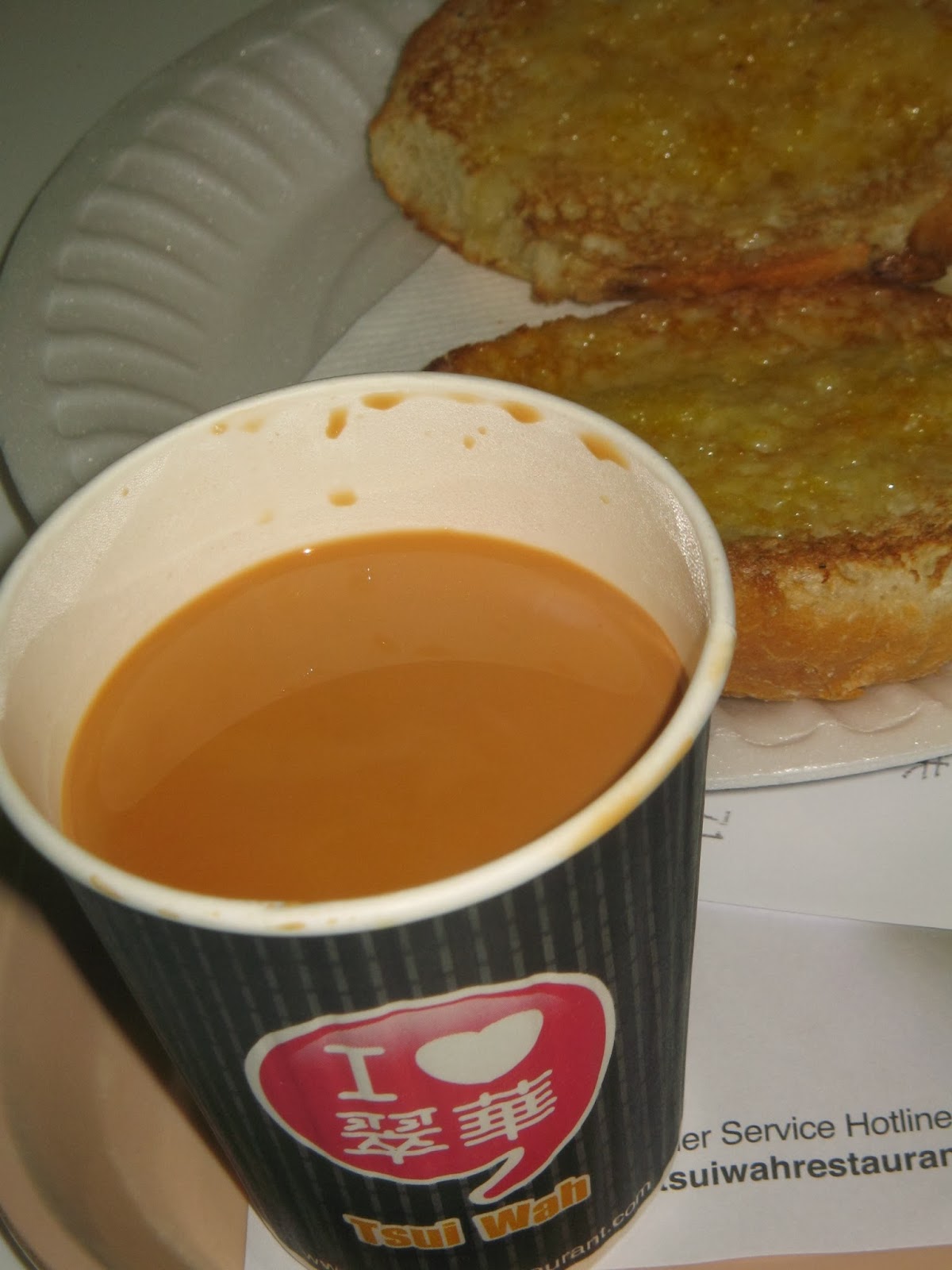
A hot cup of nai cha or milk tea and a couple pieces of sweet buttered toast from Tsui Wah, plus a bowl of fish noodle soup,  were the last things I had upon leaving Hong Kong.

Tsui Wah’s buttered toast was one of the things that made an impression on Anthony Bourdain during the Hong Kong episode of The Layover. I found the shop by the busy Des Voeux Road Central, on the other side of Connaught Road Central along which it is parallel, a large tea house all in glass walls and windows. But this must not have been the original stall that Anthony Bourdain visited, for that was just a tiny, hole-in-the-wall affair.


Anyway, trying this and that and looking for other things besides, the chance to try Tsui Wah slipped me by. But still, luck was on my side, because Tsui Wah was at the departure area of the Hong Kong airport. So I arrived early for my flight, and sat down to savor my last hour in Hong Kong with one of the city’s famous offerings. 

The nai cha was how it should be, hot, creamy and not too sweet, the full-bodied tea providing a jolt to the senses. Which reminds me – in all of the four days I traveled along the expanses of Queen’s Road Central to West, Connaught Road Central to West, and Des Vouex Road, and exploring the malls all around Central,  there was only one cold bubble milk tea shop I passed by, and that was a Gong Cha stall. 

Hot milk tea – without the bubbles – can be ordered almost anywhere, though, especially in those tiny, family-run noodle shops. And of course there were all the teahouses serving complementary hot tea to your heart’s content, but without the milk. 
But as for Tsui Wah’s buttered toast, which came slathered with condensed milk, I wasn’t too impressed. In fact upon the first bite I wondered what all the fuss was about. It was just an ordinary bun made chewy by the butter and condensed milk heating up to a slightly crackly thin layer after its stint in the oven. 

It can be easily replicated at home, using better bread and taken to a myriad of directions. With cheese? Cream cheese! Or strawberry jam. Cream cheese and strawberry jam! Or mango jam! Even just simply butter – good, salted butter – and a generous sprinkling of white sugar, grilled until the sugar crystals have almost caramelized.
My bowl of rice noodles and fish balls was bland, as expected. All three were incidentally among Tsui Wah's top ten dishes. Tsui Wah’s milk tea is sold in take-home plastic bottles, so I bought several to compensate for the tetra packs of tea and cans of creams soda in my backpack that immigration officials confiscated because I forgot to insert them into my check-in luggage. The bottles were some of the things I brought home, along with several orders of baked buns from Tim Ho Wan, and a heaping of memories of food newly discovered and rediscovered.
But before I leave Hong Kong entirely, let me include a few other photos taken at the expansive Chek Lap Kok airport. 
  The female CR must be one of the most mother- and child-friendly lavatories in the world.

No, this is not a mirror image. And with that to muse over, I boarded my plane. 


Tsui Wah Restaurant
Website


Related Posts

Friday, April 11, 2014

Hong Kong: Cliftons

The seminar I attended in Hong Kong was held at a Cliftons training venue  right smack in the middle of Queen's Road Central. The venue provider also catered the three-day event, providing breakfast, lunch, and mid-morning and mid-afternoon snacks. 

Before the seminar I wasn't at all happy that I will be provided most of my meals for the day. I envisioned lackluster Western dishes designed to please varying palates - in short, safe and oft-repeated standards. 

And that is what met me on my first day. Breakfast was sausages, eggs and some breads. I had indulged breakfast at my hotel, so I congratulated myself. I wasn't in Hong Kong to eat sausages. 

Lunch, however, was a revelation. There was a total turn-around, and it became hardcore Chinese. There were dishes that even came across as exotic, ones  I could never have come across no matter how hard I scoured the restaurant scene across Hong Kong. I would never have ordered them, for one, if they were available, since they were remotely unfamiliar. But here it came free with the tuition that the agency I work for had paid.  

And there was confirmation of the food's pedigree - my favorite classmate, the one who pointed me to Tim Ho Wan and who explained how to eat congee and soy milk for breakfast, declared that everything was "surprisingly good."

I didn't find everything that palatable, though. That dish above, for example, was labeled steamed angelo lufta and glass noodle in garlic. I'm sure there was some sort of mistranslation or misspelling there, for no matter how I researched I could not find what lufta or angelo are anywhere. But it's some kind of gourd, very much like sponge gourd or patola (which is spelled luffa), but not as slick, and very, very bitter. It has a different bitterness from, say, ampalaya, or even papait. The large slices further emphasized the bitterness, so needless to say I didn't enjoy it very much. 
This one is more familiar, called braised lo hon vegetables with bean curd. "Lo hon" is this revered vegetable mix called "Buddhist delight" because it is eaten by Buddhists, and is traditionally served in Chinese households for the first five days of the lunar or Chinese new year for self-purification practices. At Cliftons the vegetarian dish was mixed with glass noodles. 
Another vegetarian noodle dish, egg noodles with mushrooms. 
Smoked duck breast and peppered pastrami beef, which were very good eaten together with the vegetarian noodles. A bit irreverent, yes. I would have preferred those heavenly slices of duck with noodles in soup, though. 
I always enjoy the variations of Chinese rice, fried or otherwise. I had plenty to enjoy at Cliftons, like steamed rice topped with chicken a la king, or stir-fried yang chow style. 

No, liquid is not waste. Or is that, waste is not liquid? Or no liquid waste should be thrown here? This was a notice posted by the water dispenser. 
The cream soda is a popular carbonated drink in Hong Kong, said to taste like a mixture of milk and 7-Up. It tasted like shandy to me, and a can was a good way of helping me digest all that I ate as I got ready to end the day and start exploring Hong Kong, fueled and ready eat more.


Related Posts

Thursday, April 10, 2014

Hong Kong: Hotel Breakfast

Because there were a lot of interesting things to eat around the area where my hotel was located, I had been tempted to forego the free breakfast included in my hotel package. But I inspected the spread on my first morning, and found it equally interesting so I had breakfast there. And I got hooked that I ate breakfast there for all the days of my stay in Hong Kong. 

It had the usual hotel breakfast features, but it had distinct Chinese accents. I always started with a plate of fresh fruits - there was  my favorite Hami melon, and bananas probably from Davao down south in my home country, sweet pineapples, and braised plums redolent of masala. 
Then there was congee, the bland Chinese rice porridge that was a perfect canvass for the contrasting textures and flavors of the various toppings on offer - fried salted peanuts, pickled vegetables, meat floss, fried wonton wrappers. The excellent chili paste did wonders in spicing things several levels up.   

The congee metal container sat on a warmer side by side with another container filled with warm and sweet soy milk. All around them were bowls and saucers, but no single mug or cup was visible. This perplexed me, for naturally I wanted to drink the soy milk from a cup. 
So I again consulted my Chinese classmate, who gave me the heads up on Tim Ho Wan, and it was explained to me that yes, soy milk was drunk from a bowl. But here's another interesting thing - he further explained that congee and soy milk were usually eaten together for breakfast.  

So from then on I had congee and soy milk together, and yes, I had them both from bowls. 
There was always pancit, or stir-fried noodles, in one form or another. I  noticed mainly Chinese males eating them. I am a noodle-lover, always was, but the noodles didn't appeal to me much - mainly because I was so used to the Philippine version that feature a heap of various toppings from meats to balls to vegetables and even deli meats, that I thought I didn't know how to eat this kind of noodles. For it was just stir-fried noodles, and not much else. 
Not wanting to miss an opportunity to learn, I ate the pancit, of course. I tried all there was to try, every single morning. There was bihon - thin stick noodles - one day, and there was a thicker glass noodles another day. They came slick with sesame oil and soy sauce, but every single day they came unadorned. 

There was always dim sum - which couldn't compare with the ones I had at Tim Ho Wan or Lin Heung Kui - so I mixed them in with the noodles. Sometimes I got fried chicken or fish fillet or deli meats to mix in, too. Maybe this was how noodles was made to be, to be a side for viands, while pancit  in the Philippines evolved to become a one-pot dish. 


Related Posts
Eating Around Sheung Wan
Strolling Around Sheung Wan
Sheung Wan Dried Seafood Market 
Lin Heung Kui
Yung Kee
Tim Ho Wan
Cliftons Event Catering


Tuesday, March 04, 2014

Hong Kong: Sheung Wan

I arrived in Hong Kong famished. I had made the mistake of assuming that, since my flight was noontime and because my booking had said I would be served a meal, I’d be served lunch. It turned out a meal on a one-hour lunchtime flight was just a small piece of pork bun.

But it was just as well. I make it a habit to eat very light before I arrive at my destination, anyway. The stomach should have enough space upon arrival so it can cope with eyes so rapidly scanning all the new culinary treats within reach, and a mouth that chomps faster than a hand can feed it.

So I supplemented my measly bun with Anthony Bourdain’s The Layover, which showed the Hong Kong episode, of course, and re-read my research notes compiled two weeks before. It was fantastic that the TV show reiterated my internet browsing. So as my plane touched down Chep Lak Kok I had a solid itinerary fit for the food gods.

But alas, I also have this absolutely resistant habit of staying up throughout the night before an international trip, packing, repacking, checking things, and generally tarrying about everything. So always, always, I arrive at my destination loopy and ready to drop for lack of sleep.

After managing my way around the massive airport terminal, changing currencies, buying tickets, sitting out the one-hour bus ride to Hong Kong Island, and walking two blocks from the bus stop to my hotel, it was four o’clock and getting dark, and my knees felt like butter. By the time I had checked in and left my things in my hotel room I was starting to shake from hunger.

I had to scrap my itinerary, which involved managing to find the tram station to get into Hong Kong Central, as there were no subway trains servicing the area I was billeted in. It was also my first time to navigate Hong Kong island, being more familiar with the Kowloon side. I didn’t have the energy to look for the restaurants recommended in my research, but I had to find food fast.

So I decided to make it an opportunity to explore the neighborhood I’ll be in for the next four days. It was the right decision, for walking just a few meters I was rewarded with the sound of a heavy knife whomping on a wooden board. The glass window revealed cold chicken being chopped, then peppered with seasonings from several bottles. One wall showed a framed shot of a long line of salivating buyers from what I assumed to be the original outlet, and a rendering of an organic-looking chicken in a farm. 
I promptly fell in line, and when it was my turn I was told that the minimum order was half of a whole chicken. I didn’t care, as at that point I felt I could finish a whole pig. There was no dining area since the entire establishment was just a take-out counter, so I walked back to the hotel thinking I’d just eat in my room. A block after I found myself in the midst of noodle shops sitting side by side, in front of which were enticing pictures of steaming bowls perfect for the cold weather. 

I went to one that had a lot of people inside, hunkered down to their bowls. Interestingly, this noodle shop did not have tempting photos on its façade. No photos in the menu, too, and I was getting worried after I had been given a table. Good thing the owner, who, typical of the Chinese, minded the cash register, noticed at once and gave me a translated version. 
I ordered the roasted duck noodles, and the first thing to land on my table was a glass full of smoking hot water. My mind reeled. Was I supposed to dunk in the chopsticks and soup spoon that came soon after, to sterilize them, as is typically done in hole-in-the-wall carinderias in the Philippines? But in my country, though, spoons and forks come in already immersed in hot water.


So I had to ask, and the waitress gestured that the hot water was for drinking. Ah, ok. I had ordered nai cha, too, so after the hot water, the hot milk tea, and the scalding noodle soup I was all toasty and warm, relaxed as if I had lain in a hot bath for hours. I was also full, because the noodle shop owner graciously allowed me to eat my steamed chicken along with my hot bowl of noodle soup. Bliss.
Afterwards I had to fight off sleep, because walking back to my hotel I saw this dessert place that offered shaved ice. Never mind the winter cold, my belly was on fire from all the hot things I had eaten and the desire to eat more.
The flavors for the shaved ice were quite interesting, like marshmallow and durian, but I settled for the soya, which I thought to be quite Chinese.  
And so my first day in Hong Kong ended finely. It did not go according to plan, and I did not get to sample right away those restaurants that made such a flash in the radars of foodies. But I had quite an adventure all my own, spontaneous, unstructured, and fulfilling.  


Related Posts
Strolling Around Sheung Wan
Sheung Wan Dried Seafood Market
Lin Heung Kui
Tim Ho Wan
Yung Kee
Hotel Breakfast
Cliftons Event Catering

Monday, September 09, 2013

Berrrrr Time

 It's September and the malls have started playing Christmas songs. I hate that it's so early, but I've gone and visited that mother of all shopping meccas, the venerable Divisoria. I went with another Divi-veteran, who introduced me to the food pleasures of 168 Mall.
We had miki-bihon pancit guisado at Chopsticks and Spoons at the 5th level food court, with a humongous special siopao, which had asado filling half of the interior of the soft dough. and bola-bola with salted egg filling the other half. The pancit was full of sahog, and was cooked to order so we got it fresh and piping hot.
 The fruit selection is more interesting, with several pear varieties. No hami, but there were carts full of cherry-looking things that vendors said were cherry apples that were being sold for Php100/kilo. 
It turns out these were a kind of Asian crab apples, and the moniker is correct. They look like cherries, but they have the flesh of apples. Tart apples, that is, like green ones. Very firm flesh, crunchy and juicy, with the same uneatable core. 


Related Post

Thursday, March 21, 2013

Pancit Negra

An absolutely meatless variant of the popular Pinoy dish pancit, or stir-fried stick noodles (bihon).

Pusit (squid) in various sizes is plentiful these days in Cavite. Finding some seemingly infant ones at Php40 for a small saucer's worth, I thought it would be nice for some seafood pancit at home, along with a handful of little shrimps.

I like to use "Super Q" bihon, which cook to a soft bite. The noodles are usually pre-soaked for an hour or two.

The shrimps were peeled, the shells, heads and tails steeped in hot water. The hot water was strained into a small pan, the shrimp peelings put into a mortar and pounded. More hot water is added, then again strained into the pan. These steps were repeated until the shells were pounded to a fine pulp.

The squid "plastic" skins were peeled, the plastic "swords" and everything else inside removed. I usually remove the eyes, but for their sizes it wasn't necessary. They were then sliced.

I fried a whole head of garlic, peeled and minced fine. When they were getting all blistery I put in the peeled shrimps, then the squid slices, stirring them around the frying pan. Everything promptly turned black - I wasn't able to entirely remove the squid ink sacs.

I became color-blind at this point, and proceeded cooking. I transferred the seafood mix onto a plate, then poured the shrimp water into the pan, seasoning with patis, ground black pepper, chopped wansoy (coriander/cilantro) and thinly sliced celery stems. When the shrimp broth was boiling, the pre-soaked noodles were added, then stirred until most of the liquid was absorbed.

Stir-fried noodles have to be served immediately. My pansit guisado had turned ebony instead of bronzy. Ignoring gasps from the kids, I twirled it onto a plate and heaped the seafood mixture on top, along with finely minced garlic fried to a crisp and chopped spring onion. For added flavor and crunch, I even mixed in crispy tahong, a pouch of which I bought in Bacoor.

It looked totally unappealing, and the kids shook their heads when offered some. But I had learned from my mother that an extremely frightening mulagat (big eyes) would go a long way in instilling obedience in children, so I applied the technique. The kids ate, tentatively and with eyes squeezed tight.

My kids inherited my love for noodles. In no time at all they were scraping their plates clean. The eldest, who feels squeamish about the texture of squid - I don't know why - asked for seconds. I had seconds, too, for with the fried garlic and a squeeze of kalamansi it was actually, terrifically! good.

Being averse to pork for the longest time I had a hard time eating pancit in restaurants, for most feature fatty slices of pork, and were stir-fried in rendered pork fat. Having eaten pancit choku at revered Asiong's Carinderia I knew my favorite noodles can be awesome without pork, or any meat at all. And now I know we can have it at home, too.   

   
Related Posts
Pancit En Su Tinta Choku
Aligue Palabok
Misua
Lukban Miki
Pangasinan Pancitan
Pancit Cagayan
Pancit Hab-hab

Monday, March 18, 2013

Mitsuyado Sei-men

There's a Japanese noodle shop I've been frequenting these last few months, bringing different sets of friends to introduce it to. But with the hot months set to prevail upon the country I'm afraid I won't be going back there soon.

The restaurant has a very short menu. And most of the showcase items - noodles in thick, rich, visibly oily soups - seem to have been made for colder climes. It's a Japanese restaurant, after all. 

Occupying a whole page of the 3-page menu is the tsuke-men, claimed to be the current rage in Japan. A sort of deconstructed ramen, it's wonderful with its thick, absolutely chewy noodles that is more substantial than ramen but is short of the ampleness of udon. 

The noodles are served separately from the soup, because they are dipping noodles. The bowl of robust soup, or more appropriately dipping sauce, calls to mind a boiled down kalbi-jim. Richness is cut down by an undercurrent of kumquat, or probably yuzu. So that you come to understand why the noodles have to be cut that fat.
The restaurant prides itself in its soups - so much so that salt is unneeded. You are invited to yield to the layering of flavors. In the myriad of bottles in the condiment tray that entices one to shake and douse and sprinkle, not a bottle of table salt can be found. I tend to hog the chili-sesame oil - heat is mandatory after several spoonfuls of richness.

Particularly since the specialty of the house is cha-siu - paper-thin cuts of pork belly that all but melts in your tongue like a smear of butter. Good quality butter. It's as creamy, too.
There are several variants of ramen, and you can choose which noodles to come with it. I like ramen, so I order the thin noodles, but they're still broad enough. And that is because the ramen broths are full-bodied, too, with a sheen from the coating of oil. My spicy miso ramen is blood-red, but the heat isn't enough and it soon cloys.  
In February there was a limited run of squid noodles in ramen and kae-soba versions. I tried the ramen, and the broth was black from the ika ink. There were a lot of things going on, on top - sauteed tomatoes, a slice of that cha-siu, silky soft-boiled egg, grated horseradish, chopped leeks and some pickles. 

Sadly, all those things weren't powerful enough individually to contradict one another. The pickles weren't sour enough, the tomatoes bland, the horseradish lacking its characteristic zing. Even the squid flavor, despite all that darkness, was missing. To top it all off, the squid was rubbery. 

Good thing the ika promo has been replaced. Ongoing is a shrimp and salmon kae-soba promo for Lent.

After all the lavish dishes I find comfort in what's simple. Like a plate of simply salted steamed edamame. How I licked those grains of salt! And the crackly chewy gyoza, which must be the best I've tried. I can't remember which gyoza I used to like best, but this now tops the list. It makes me forget all the rest.

That velvety soft-boiled egg can be ordered by itself, along with a side of simply steamed yasai. If I go back these are just what I'd order - I've had enough of luxuriousness for a while.
It's marvelous, though, to step from the street into a place that makes you think you stepped into a hidden alley.  
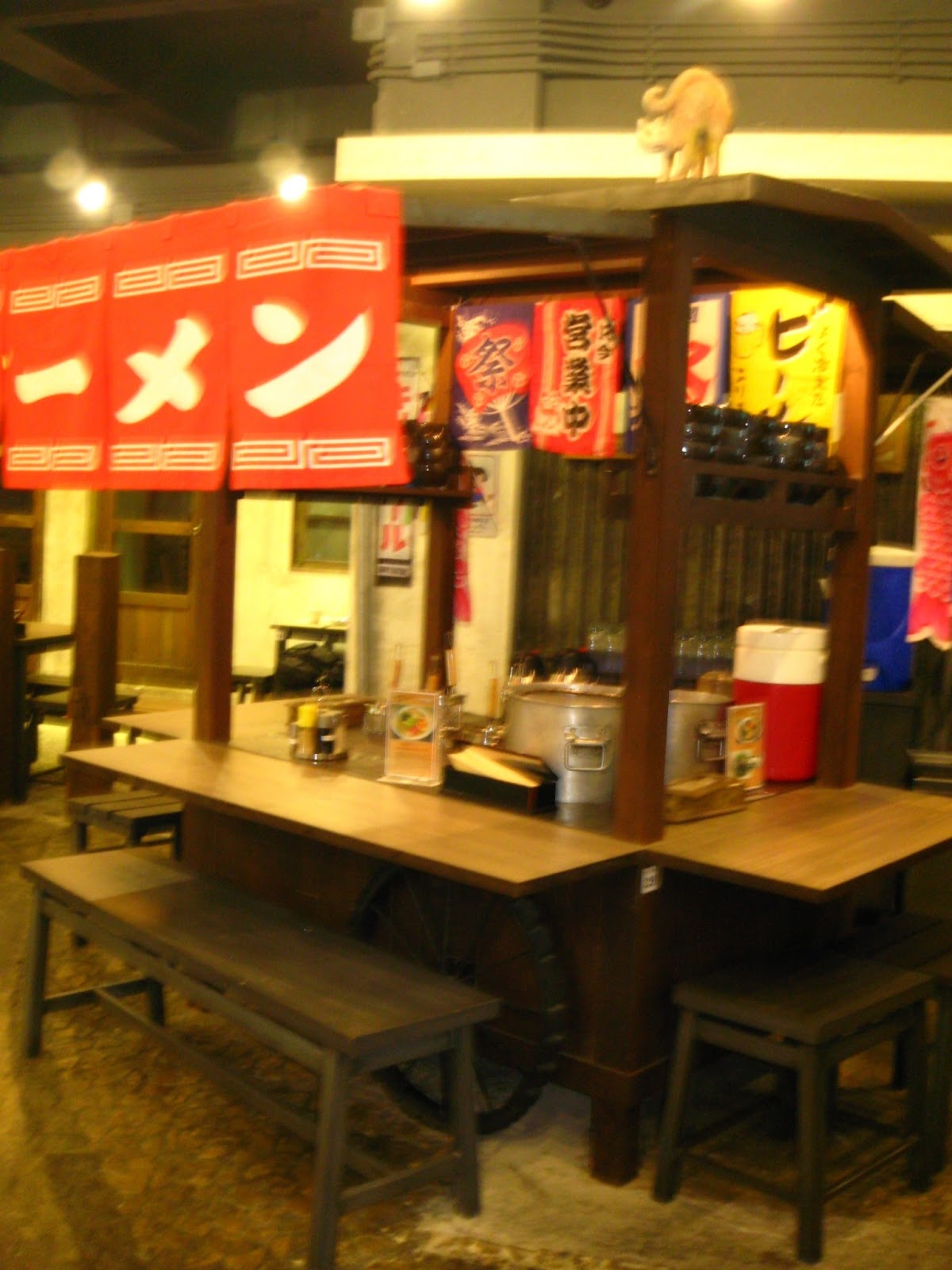
With a noodle cart, the al fresco ambience is completed by roughly paved floors imitating old Japanese streets. There's a wall of broken tiles - as it was in Hiroshima, perhaps?


Mitsuyado Sei-men, House of Tsukemen
22 Jupiter Street, Bel-Air, Makati City
(632) 511-1390, 511-1759


Related Posts
Rai Rai Ken
Chao Long