Thursday, July 31, 2008

Manok tan Labong

[Chicken with julienned bamboo shoots in broth]

It's been sufficiently cool lately, with rains brought about by hanging habagat (the southwest monsoon), ITZC, and the onslaught of several typhoons, that we've taken to having soup for dinner almost every night, to soothe the soul as much as to ease the physical chill.

The rains have dumped enough water to flood many places, the winds of the more vicious typhoons overturning two large ships and 21 smaller ones. Such is life in an archipelago. Always in peril.

But the rains are a necessary part of island life. For the source of piped-in household water. For electricity generated by hydropower, which is a significant power source in the country. For the source of irrigation for fields planted to the Asian staple, rice. For the general rebirth of life, from previously dry creeks and rivers, and the soil that had temporarily existed as dust.

The rainy season, a bit late in arriving from this year's extended summer, is usually heralded in our house with the appearance of labong - bamboo shoots - on our table. Groves of bamboo thrive at the back of my husband's family house, which is the usual source of our labong supply. In Cavite, labong can sometimes be had outside of the rainy season, probably because of the numerous waterways criscrossing the province, but these are rare occasions, relatively.

Labong is commonly cooked with saluyot, and this is the only vegetable that it is paired with that I know, in Pangasinan. But it is also cooked on its own, in broth with either chicken or pork.

Labong is used in most parts of South Asia, usually in gata (coconut cream) or in a stir-fry. In soup, labong is a main ingredient in the Chinese hot and sour soup, and in the Lao dish kang nor mai (bamboo shoot soup). The soups, though, are usually thick.

Labong soup in the Philippines, at least in Pangasinan, is clear broth. It is actually a dish like tinola - chicken in broth with vegetables. But instead of the vegetables (usually young leaves of sili and sayote, or green papaya and malunggay), the chicken is solely accompanied by labong, the soup spiced with ginger, onions and salt.

This is a fortifying soup, though not really filling, so it is eaten with rice. But it is laden with the purportedly heartening properties of chicken, enhanced by the benefits of bamboo. Incredibly, the nutritional value of bamboo include potassium and phytochemicals, aside from fiber.

Great soup, too - the goodness of chicken with a slightly woody dimension, soft (meat) and crunch (labong) together in a mouthful.


In a fresh pot of water put in chicken, thinly sliced ginger and onions, and a pinch of salt. Let boil until chicken is tender. Add previously boiled labong and cover, letting it simmer for about 15 minutes more. Season to taste. Freshly cracked black pepper can also be added for flavor. Serve hot.
Labong is usually sold julienned and pre-boiled. Pre-boiled labong is colored yellow, while raw labong is pasty hued. Pre-boiled labong can be kept in a tight container and placed inside the refrigerator until it is used. Raw labong should be boiled before storing. Boil for about 20 minutes, then discard the water. Drain well before storage.

If using labong that was pre-boiled when bought, boil in a pot of water for a few minutes before adding to soup. Check and boil longer if it is still not tender enough to eat. Discard water and add to cooking chicken.


Related posts:

Sunday, July 27, 2008

Belgian Chocolate Cake

[Sinful Chocolate Cake]

Cake of the Month
As the family marks my third child’s progress onto her first year, I will be celebrating her monthly birth day in this blog by featuring a cake. Lined up for the next twelve months, and hopefully on afterwards, are old-time favorites, reliable standards, as well as new discoveries, as I go on a quest for the best cakes around the country.

A La Creme, or Cil's a La Creme Cakes, Crepes, Coffee, by Cecille Marie R. Bansil, is a cakeshop cum cafe and dessert place in San Fernando City, Pampanga, and second of the four recommended food places during my one-day trip to the city.

It is one of those food places in the provinces which has been known to my office colleagues for quite some time, from pasalubong of their counterparts in the provincial branches of the agency I work for.

It is an ingrained Filipino custom to bring food whenever you meet acquaintances, and we are the luckier for it. Branch officemates often request Krispy Kreme, which has so far opened outlets in Metro Manila only, but when it is their turn to visit (officially, of course), we receive a plethora of treats from the Philippines' 7,000 islands.

Aside from tibok-tibok, our colleagues in San Fernando City frequently bring the Sinful Chocolate Cake from a La Creme. Those dealing with branch people rave about it, saying nothing quite like this cake can be found around Metro Manila.

The cake doesn't usually last long enough to reach me, so its sinfullness had all just been hearsay. But after spending about a thousand pesos on tibok-tibok, mochi, and palabok at Susie's (from there the volume of food I took home could be guessed, since these native delicacies are quite cheap), I made a La Creme my second stop-over. Luckily, the two outlets are just about a block away from each other.

I asked the person manning the counter what the bestseller is (I don't know if this practice is right?), and she confirmed that it is the Sinful Chocolate Cake (whole cake about Php790, mini Php440, slice Php79).

Despite my aversion to chocolate cakes (make that bad chocolate cakes), I had to sample it.


It is actually a chocolate mousse, interspersed with very thin, crunchy walnut-brownie layers, and set in shape by thin chocolate shards, each branded with the cakeshop's name, then finished off with a red ribbon. A slice is served with chocolate fudge sauce.

And sinful it truly is, literally - it was so sinfully sweet that after the first bite I could feel each and every, single, cell of my body perk up then go into hyperglycemic attack.

Probably because of that sugar overload, the mousse is very, very chewy - gooey - not your usual mousse with ice cream consistency. This, is full, 200% fat creamy mousse, and 500% sugar. I couldn't take a second bite, for deathly fear of becoming faint from my blood glucose shooting up.

But I had to find a redeeming value. I was in San Fernando for only a day, and I was determined to make the most of it, not caring if I become more sinful.


My salvation came with this solid brick of a cake, the second bestseller (see? I thought that practice of going along with the flow and joining the bandwagon wasn't good at all!). This, is the Belgian Chocolate Cake (about the same price as the Sinful). It was so dim inside the cafe that I couldn't take a proper photo - but it is quite obvious that this is one whole dense mass of a chocolate cake.

It is chocolate pound cake spread with a thin chocolate ganache and decorated with chocolate discs dotted with chopped nuts on top. It is so dense a needle wouldn't have gone through. It is so dark it is almost pure, 100%, chocolate. So silky and rich, and black as death.

And this time, as if somehow making up for the sugar overload of the Sinful, this Belgian is almost sugar-free. The dark chocolate is so overpowering the sugar was reduced to a hint. It screams CHO!--CO!--LATE!

Black is beautiful. And delicious, too. Delicious. Have I said delicious?

Delicious.

Now I know the best chocolate cakes are outside of Metro Manila.


a La Creme
MacArthur Highway, Dolores
City of San Fernando, Pampanga

The first food outlet I went to in San Fernando City, Pampanga
Susie's Cuisine

Cakes of the Month
Divine Chocolate Cake, by Divine Sweets (Puerto Princesa, Palawan)
Cakelines, by Jon-Rhiz (Cavite City)
Dayap Chiffon Cake, by Kiss Cafe (UP Diliman, Quezon City)
White Chocolate Mousse, by Gateau de Manille (Katipunan Road, Quezon City)
Mango Cake, by Red Ribbon (with branches nationwide)
Ube Cake, by Goodies N' Sweets (several locations across Metro Manila)
Mango Charlotte, by Sweet Bella (Dasmarinas Village, Makati City)
Strawberry Shortcake by Vizco's (Baguio City)
Almond Chocolate Fudge Cake by Malen's (Noveleta, Cavite)
Caramel Cake by Estrel's (Quezon City)
Marshmallow Birthday Cake by Estrel's (Quezon City)


Monday, July 21, 2008

Susie's Cuisine


[A bilao of mochi]

I happened to be in the City of San Fernando in Pampanga for one day due to work, and prior to my trip I had asked around for suggestions on what delicacies to sample. Four food destinations were emphatically stated as musts, one of which should have covered my lunch.

However, a colleague at our branch in Sn Fdo happened to celebrate her birthday with a luncheon party while I was there, so the lunch place was out. Which left me with three out of the four. Not bad, for a city in a day.

Foremost of the suggestions was Susie's Cuisine, purveyor of Pampanga's native delicacies, in the central plains of the island of Luzon. I had sampled the popular fare before as pasalubong from friends and officemates, so I was happy to indulge myself and the family to the treats.

There was an outlet near the branch of the agency I work for, and waiting right by the counter of the outlet were two bilao of mochi, the inspiration for a buchi experiment among me and two friends - baked buchi.

But unlike that buchi, which was baked with the gata (coconut cream), the mochi was cooked on its own, and then sold with a separate sweetened gata to pour on when it is time to eat it.


The gata was thick and silky, and sweet to compensate for the otherwise bland rice dough and bean paste filling of the mochi. At Php5 per piece, it is a cheap but heavy and satifying dessert, or merienda on a lazy afternoon.

I like to eat it hot, with the mochi steamed and the gata heated to almost boiling. I could easily finish ten pieces, and, needless to say, I bought an entire bilao. To share, of course. ;-)


But my main purpose for going to Susie's was the tibok-tibok - sweet carabao milk pudding accentuated with dayap and topped with latik, or coconut cream curds.

It is also sold by the bilao (Php400), as well as by the slice (Php20). It is considerably more expensive because carabao milk is not commercially produced.


I love tibok-tibok - I love its velvety smoothness that caresses the tongue, its creaminess that engulfs the palate upon swallowing, and the punctuations of citrusy essence that the dayap provides, which foils the creamy progression of each spoonful, letting one go from one slice to the next. And the next. The latik topping gives a crunchy dimension to the texture, as well as nutty points to consider, bite after silky bite.

Have I said I love tibok-tibok?

It is like maja (blanca and con mais) - that common local sweet delicacy made with gata and cornstarch, but not as set as it is bound to be when too much binder is used, or when not stirred enough while cooking. It can also be compared to panna cotta, but which is gelatin and so sets a little harder. Tibok-tibok is silken soft, readily turning into mush when not handled properly.

Ever since the family relocated to Cavite I have been wanting to make tibok-tibok, since fresh carabao milk is available every morning where I now live. The milk lasts only for a day, even when refrigerated or frozen, so I was thinking tibok-tibok is one way of extending its shelf life, along with kasilyo, the local white cheese. But I haven't found the time to make both yet.


Susie's pichi-pichi (steamed cassava balls), naked because the grated coconut that should have enrobed them is also sold seaprately, so it can last up to three days (the coconut-covered kind is good for only a day)

This is a bit gummy, or chewy, rather like a green kutchinta in consistency.


I had to include Susie's pancit palabok (Php40 per serving, good enough for two) in my take-home bag because it was also a recommended item, the main reason being one order is overflowing with noodles that it is such a bargain. I also remembered that this kind of pancit purportedly originated in Pampanga.

I was hesitant, though, because I don't care much for the pancit palabok at Razon's, a restaurant serving Kapampangan specialties. And just because one serving is good for more than one person doesn't automatically make it delectable - Filipinos have this tendency to rave about restaurants or food outlets that offer huge servings even though the quality and taste of the food, which are the more important factors, are not particularly worth raving about.

Anyhow, I bought four packs, two for a colleague who asked for them, and two for the family, because the husband will only eat pancit that has palabok on it. During the ride home the pancit's aroma was so enticing that I worked up such an appetite.

I had one pack for dinner. One pack was shared by my two preschoolers. One pack was grabbed by the husband. And the last pack was squabbled over between the four of us the next day. Which left how many for the colleague?

What did I know? It was the best - the best - pancit palabok I have ever eaten in my entire life. The noodles used were not the usual bihon (dried stick noodles) but a thicker kind - I haven't encountered it anywhere before - much like cappellini, or even angel hair pasta.

The palabok sauce was delicious - very, very tasty - thick yet readily absorbed by the thicker than usual noodles. It was darker, too, close to being red. The multitude of flavors that is the charateristic of palabok was sufficiently evident, satisfyingly rounded up by a squeeze of calamansi.

I gave a pack full of tibok-tibok to my colleague in lieu of the palabok. I'll remember to buy more palabok packs when I get to visit Susie's again. Hopefully soon. There is a branch at East Avenue in Quezon City, I hope they have palabok there.


Susie's Cuisine
  • McArthur Highway, Dolores
    City of San Fernando, Pampanga
    (045) 8612480/9639302
  • Rizal Ext. cor. Sandra St.
    Angeles City (045) 8872479/3235704
  • #36 Hilda St., Nepo Mart
    Angeles City (045) 3224775/8880034
  • La Maja Riza, McArthur Highway
    Ligtasan, Tarlac City (045) 6112150
  • Pineda Bldg., near Marina Arcade
    McArthur Highway, Dau, Mabalacat
    Pampanga (045) 8924919/3315622


The second shop I went to in San Fernando City is a La Creme


Related Posts
A Weekend in Chinatown
Bibingkoy in Cavite
Baked Buchi recipe
Home-Made Buchi

Tuesday, July 15, 2008

Josephine's Restaurant Tagaytay

[Grilled Seafood Platter]

Outlets of restaurant chains in Metro Manila have now overrun Tagaytay City that choices for a meal in the cool mountain ridge (believed to be a volcanic caldera, or the lip of a volcanic crater) city is like choosing from among mall tenants.

Thankfully some unique (by which I mean they are stand-alone, usually local) restaurants remain, although most of these have fast turn-overs (I once asked my husband to drive from the rotunda all the way to Alfonso and back looking for a particular local restaurant, not realizing that a Metro Manila chain has taken its place).

It is actually great to just descend on the unassuming nipa huts along the main road and have bulalo (slow-cooked beef shank bone-in, including the marrow, in clear soup). Most of the pre-cooked offerings are homely and showcases the bounty of that area of Cavite.

But sometimes we prefer dining on a grander scale. Sonya's is a good first choice, but it requires prior reservation, a hurdle when the trip to Tagaytay is on a whim. For Filipino cuisine and when we want more leeway in our ordered food, we usually go to Josephine's Restaurant, an institution that has withstood the test of time, and changing appetites.

I fist learned of Josephine's through a friend, a full-blooded Kabitenyo(a), many, many years ago. From then on I have been taking friends, and now family, to the restaurant for reliably good meals.

There is another outlet at Kawit, with an attached resort, but the food there does not compare to what is served in Tagaytay. And of course, the view, and ambience, is different, although at Kawit that is compensated for by surrounding fishponds that had seen events unfold in historied Cavite.


In Tagaytay the view is part and parcel of the dining experience. Josephine's is a prime spot. It sits close to the edge of the ridge, so it has 180-degree unobstructed expanse framing Taal Volcano and Taal Lake in splendor.

Like most Tagaytay restaurants, Josephine's is all glass walls, with water gently cascading down a stone wall by the entrance. But for a better view, perhaps while waiting for a table or for the orders to arrive, or maybe after a heavy meal, park benches are placed outside for lounging in the back patio. There is also space for open-air parties, and wedding receptions are common at Josephine's.

I once went there with a group of friends for dinner on a full moon. The experience was so enchanting, so straight out of a dream which you are not likely to forget. Out on the benches at the back of the restaurant everything was bathed in a silvery glow, the moon reflected on the two craters and the placid lake. I could almost hear the tingle of moonlight.

[Fried Tawilis]

In Tagaytay restaurants have a tendency to treat food as just a plus - a bonus to the view. Josephine's serves good food, though, so all is well.

A must to eat in Tagaytay is the fish endemic to Taal Lake - tawilis, which is usually served fried or grilled. This is similar to sardines, and can be eaten whole - scales, head, tail, spines and all.


Mango salsa (Php125, US$3), a great accompaniment to the grilled seafood (Php395, US$20), which was flavored with herbs and good for 3-4 people, and the fried tawilis (Php195, US$5).

Josephine's also serves great bulalo in a humungous bowl, but during our latest trip we sampled the kare-kare (choice of beef or tripe, Php360, US$8, good for three), which was sufficiently thick and flavorful although the peanut taste was not so evident.

Sinampalukang Manok
(chicken in broth soured by young tamarind leaves, Php210, US$4, good for three)


A large, buttery bibingka (Php90, US$2), as big as a platter and about three inches thick, steaming hot from the traditional pugon inside the restaurant, generous slices of itlog na maalat (salted duck egg) folded in the dough. A perfect way to end a dreamy meal.


Josephine's Restaurant
Maharlika West, Tagaytay City
  • with 10% service charge
  • ample parking at adjacent lot
    free upon presentation of meals receipt


Other food places I go to in Tagaytay City
Rowena's Cheese Tarts
Mahogany Market
Sonya's Garden
LZM Bangus
Bahay Pastulan
Starbucks

Wednesday, July 09, 2008

LZM Boneless Marinated Bangus


This is an alternative (not a substitute, mind you) to our beloved Bonuan bangus (milkfish from Bonuan, Dagupan City in Pangasinan).

Since we now live in Cavite, bangus (Chanos chanos) on our dining table has become a rare event. I never, ever, buy bangus in Cavite, and elsewhere outside of Pangasinan, for that matter. I've had enough maablir - or tasting of gilik, putik, or briny, mossy, pond mud - bangus that end up in the trash that I just decided to avoid it.

And with the babies and all, braving about 220 kilometers going home to Pangasinan is now too much hassle, what with Cavite and EDSA traffic extending the trip to a good eight hours.

We would need at least four days just for a chance to see the relatives and stock up on food supplies (fresh fish and daing endemic to the province, shells and crabs, newly-picked vegetables not sold in Metro Manila, rice, tsokolate, bread, puto, patopat, latik, and, uh, maybe just about everything!).

The rising fuel prices and the high toll fee at the North Luzon Expressway (NLEX) do a lot in justifying our limiting trips to the long and inescapable holidays. So most of the time we suppress our craving for good ol' bangus.

But sometimes, especially when we go to Tagaytay City, or when a friend plays a few rounds at the Riviera Golf & Country Club, we give in. To a huge, fried, marinated boneless bangus from the LZM Restaurant (Lutong Bahay Specialties), just across the club.


It is not Bonuan bangus - it is not as milky, and not as cream-ily sweet. The fat has decided hints of lansa, or fishiness. And it's huge - more than a foot long (Bonuan bangus is rarely allowed to grow beyond eight inches or so), the flesh so thick, as well as its fat. But it's good enough to satisfy our cravings until we get the time to go home to Pangasinan.

It is well marinated, with toyo (soy sauce) prominent in the marinade (as opposed to the Pangasinan marinated boneless bangus, which is steeped only in vinegar, garlic and black pepper). Before it is fried, it is dredged in flour, so that the flesh does not get tough and chewy, as bangus of this size is bound to be (in Pangasinan, this size is made into relleno, or stuffed bangus).

The scales are not scraped well enough, though, so it is left inedible (too thick to eat, anyhow). It is a bit pricey at Php250 (approximately US$8) a piece. You can get three pieces of boneless Bonuan bangus, each about six to eight inches long, at about Php60 (US$1.50) in Dagupan City. The amount of flesh and fat of all three would about approximate one piece of the LZM bangus.

But then, if fuel prices plus time and effort are factored in, LZM's is one cheap bangus. An accessible surrogate.


LZM Restaurant
  • Aguinaldo Highway
    By-Pass, San Vicente
    Silang, Cavite
  • Tagaytay-Silang Road
    Tagaytay City


Keeps in the freezer for up to a week.


Other food places I go to in Tagaytay City
Rowena's Cheese Tarts
Mahogany Market
Josephine's Restaurant
Sonya's Garden
Bahay Pastulan
Starbucks

Thursday, July 03, 2008

Pancakes

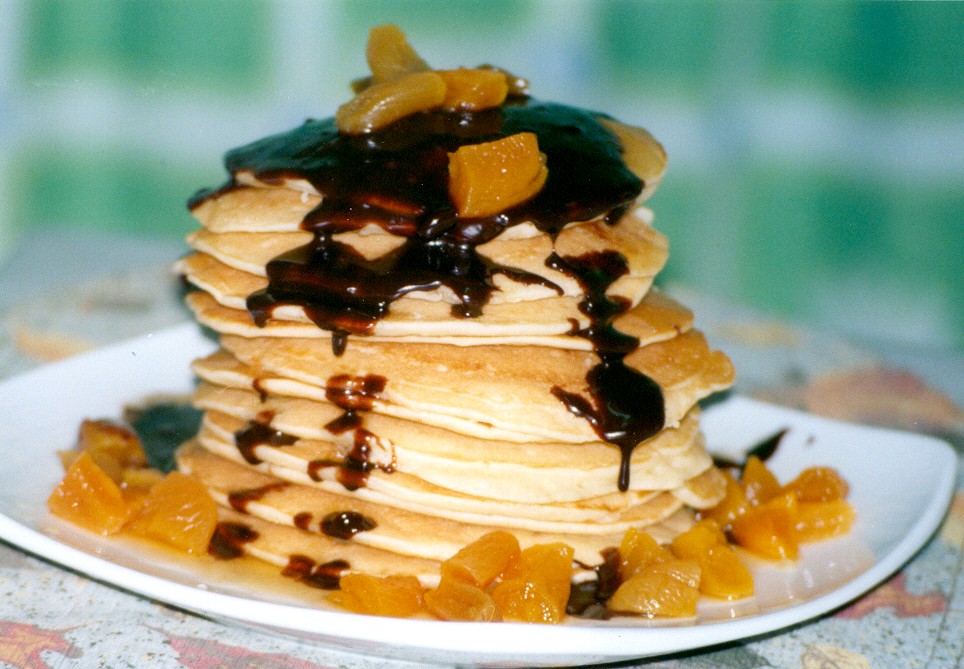
[Pancakes with chocolate syrup and chopped mangoes]

Kids are kids, and I am a grown up kid. So my kids and this big kid enjoy pancakes at home for breakfast whenever we can, but regularly on lazy Saturdays and Sundays, along with steaming cups of native tsokolate with scalded evaporated milk, so that we could linger on the table talking about nothing in particular, until it is time to cook lunch.

My children love to stack pancakes on their plates, pour honey and spread butter on them, and cut them to neat triangles, feeling very grown-up wielding bread knives. And I sigh, wondering how time flies by, that they can now slice their own food without adult assistance.

It has become a ritual, this home-made pancake breakfast, that they're not so inclined to order pancakes when we eat out. My son prefers crepes, particularly those at Cafe Breton.

I have never made pancakes from scratch. I have seen guaranteed great flapjack recipes in many blogs, but I am not disposed to try them out, yet.

That is because I've been using this wonderful pancake mix from local food and beverage manufacturer RFM Corporation, and I have never been disappointed thus far. It is sold under the brand name White King, the box emblazoned with a corresponding picture of a king with white eyebrows and white parted beard.

I'm sure those who are now into their adulthood will remember pancakes made from White King mixes when they were still children. I do, and I remember it was the only brand that we used at home.

But more than for the sentimental value, I like White King pancake mixes because they not only result in creamy, delicious pancakes, but they have even improved over the years. The White King pancakes that we make at home nowadays are so fluffy and moist, and so soft I'd like to cuddle them.

White King pancakes now come in three variants (sweetened, complete, classic), but I stick to the classic - the one from my childhood. It is already sweet that I don't need to try the sweetened version, and the complete version (no need to add eggs and butter, just water) is too dry for my taste.

Another beloved home-grown food and beverage brand is now selling pancake mixes, but to me nothing compares to White King.

We make small, thin pancakes and stack them to a tall tower, then top them with whatever fresh fruits are in season, plus sweetened whipped cream or chocolate syrup, or just condensed milk, to make a breakfast special. But plain honey and butter, sometimes with a sprinkling of cinnamon powder, are good enough any morning. As long as the kids keep me company, and I remain a kid at heart.